

Refixing before the 28 October OCR? How I’d think about it
Should you refix your mortgage before the 28 October OCR announcement? The Reserve Bank has lifted the OCR twice since July, to 2.75%, and most economists expect a hold this time with more increases over the next year. If your fixed term ends in the next few months, start looking now. Don’t wait for the announcement, and don’t sign the first rate your bank emails you.
Rates quoted are as at 25 September 2026. They move often, so check what’s on offer the week you refix.
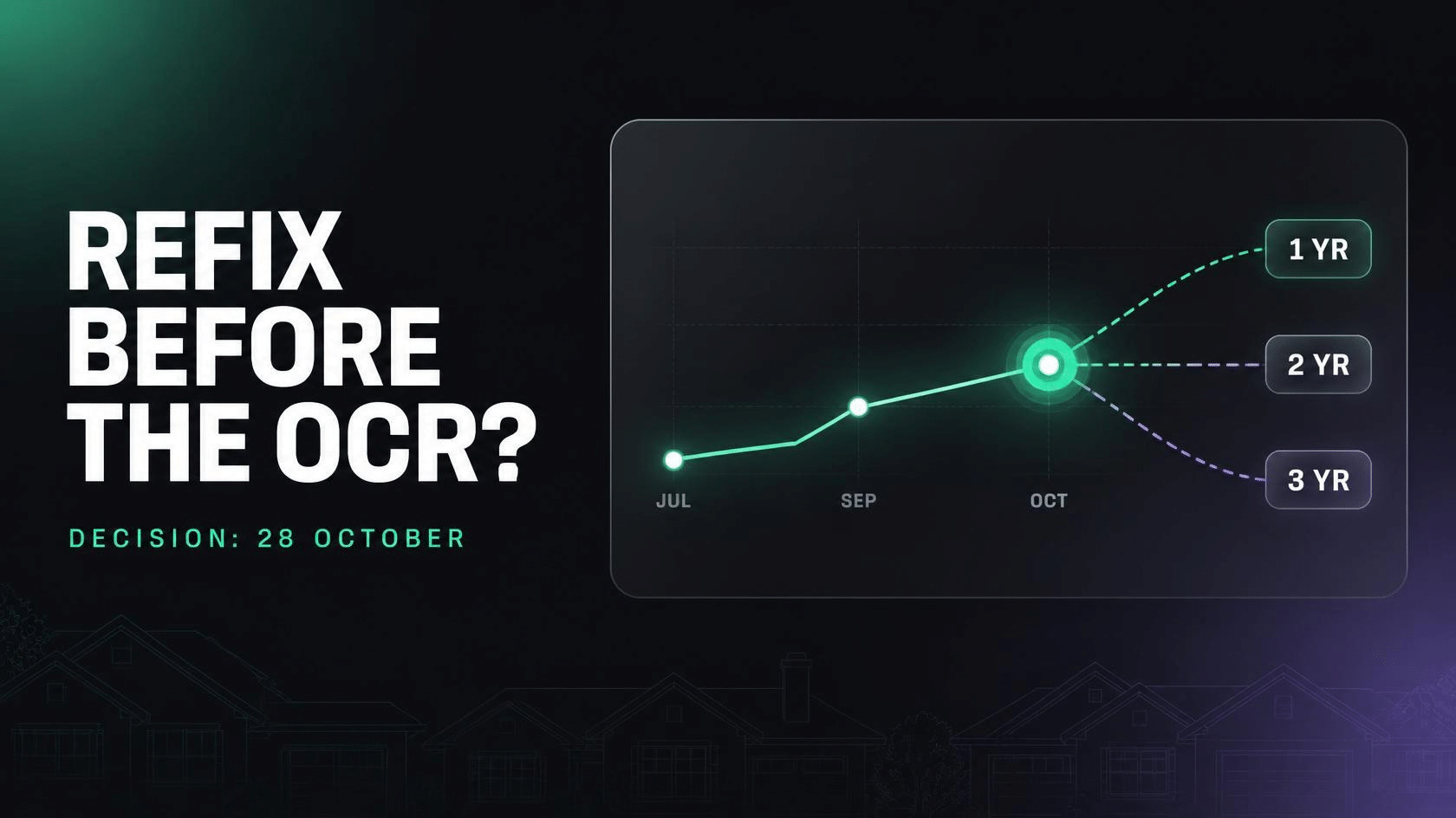
Someone in the Kiwi First Home Buyers Facebook group posted last week that they’re refixing half their loan in October and the other half in December, about $490k all up, and they’re “so nervous” they don’t know what term to pick. Another person said their adviser was pushing a 3-year fix and asked what everyone else was doing. That one got dozens of replies.
So you’re not the only one stuck on this. Here’s what I’ve been telling clients.
What happened to rates in 2026
- 8 July: the RBNZ lifted the OCR from 2.25% to 2.50%, the first increase since May 2023.
- 2 September: another 0.25%, taking it to 2.75%.
- Inflation is 4.1%, above the RBNZ’s 1 to 3% target. That’s why it’s raising rates.
- Coming up: a Monetary Policy Review on 28 October and a full Monetary Policy Statement on 9 December. The full timetable is in my OCR announcement dates post.
Markets were giving about an 88% chance of a hold in October. ASB expects the OCR to end the year at 3.0% and peak around 3.25% in early 2027. The RBNZ’s own projection is about 3.2% over two years.
Banks have lifted floating rates since the OCR started rising. Fixed rates are still lower than many people expect. As at 25 September, Kiwibank had the lowest 1-year rate at 4.95% and the lowest 2-year rate at 5.39%.
Should you refix your mortgage before or after 28 October?
Before, usually. The announcement matters less than the headlines suggest. Wholesale markets have mostly priced in the next few moves already, so fixed rates often shift before the RBNZ announces anything. If you wait until 28 October to “see what happens”, you’re usually working with rates that have already moved.
What matters more is when your current term ends and how much a rate rise would hurt your budget. Many banks let you lock in a rate several weeks before your expiry (how far ahead depends on the bank), so you can secure today’s number and still change it if rates drop.
1, 2 or 3 years when you refix your mortgage
There’s no right answer for everyone, but this is roughly how I’d split it up.
1 year suits you if you think rates will peak and start falling within a year or two, and your budget could handle a higher rate when you refix again in late 2027. It’s usually the cheapest rate right now.
2 years is the most popular term among NZ borrowers at the moment, according to the September Tony Alexander mortgage adviser survey. It gets you past the expected peak with a bit more certainty.
3 years is for people who’d rather sleep at night than squeeze out the lowest rate. You pay a slightly higher rate for longer certainty. If you might sell or restructure in that time, watch out for break fees.
Splitting is what I end up recommending most often. One person in the group is setting up a 70/30 split, with 70% on 3 years and 30% on 1 year. That’s a sensible way to avoid putting everything on one guess, and it means you never refix all of it at the worst moment. I go into this in more detail in fixed or floating.
Refix day is also the one time you can pay off as much as you like with no break fee. If you’ve got a lump sum, see how to pay off your mortgage faster.
To give you a feel for the numbers: on a $500,000 loan over 30 years, 4.95% costs about $615 a week and 5.39% about $647 a week. That’s a $32 a week gap, roughly $1,660 a year. Weigh how much the certainty is worth to you against that. The repayment calculator will run your own numbers.
Rate coming up in the next 90 days? I’ll compare your bank’s offer with the market and negotiate for you, including on loans I didn’t arrange.
Book a refix check →Ask about cashback (people forget this)
Lots of people in the group have been asking whether you can get cashback when you refix, not just when you take out a new loan. Sometimes you can. Banks have retention offers to keep good customers, but they rarely offer them if you just click “accept” on the rollover email. Ask. Better still, get someone to compare your bank’s offer with the rest of the market first. My guide to comparing rates explains why the lowest rate isn’t always the cheapest loan.
Before you refix your mortgage
- Find your exact expiry date. It’s in your banking app or loan documents.
- Check whether you can lock in early, and how far ahead.
- Think about the next 1 to 3 years: a baby, a reno, a job change, selling.
- Get your bank’s offer in writing.
- Compare it with the rest of the market, then negotiate. If another lender is clearly cheaper, the switching banks guide covers the costs.
Common questions
When is the next OCR announcement in NZ?
What is the OCR right now?
Should I wait until after the OCR announcement to refix my mortgage?
Is it better to fix for 1 or 2 years right now?
Can I get cashback when I refix?
Sources: RBNZ: OCR October 2026, Opes Partners rates, Tony Alexander survey, September 2026, CentralBank.watch.
Read next
Fixed or floating?
How to split your loan when your rate comes off.
Mortgage break fees
How banks work them out, and why many are small right now.
OCR announcement dates
When the Reserve Bank decides next.
Talk it through with Yatin. Free, no obligation, and usually one phone call.
Book a free chat →Or call 022 064 7770
This article is general information only and isn’t personalised financial advice. Mortgage Sense is a trading name of Yatin Kainth, a Financial Adviser (FSP1007497) providing advice under the Mortgage Managers licence (North West Group Holdings Ltd, FSP682791). See the Disclosure Statement.
Ready to talk it through?
Get mortgage advice NZ homeowners actually trust. Book a free, no-pressure chat with Yatin.
Book a free chat →