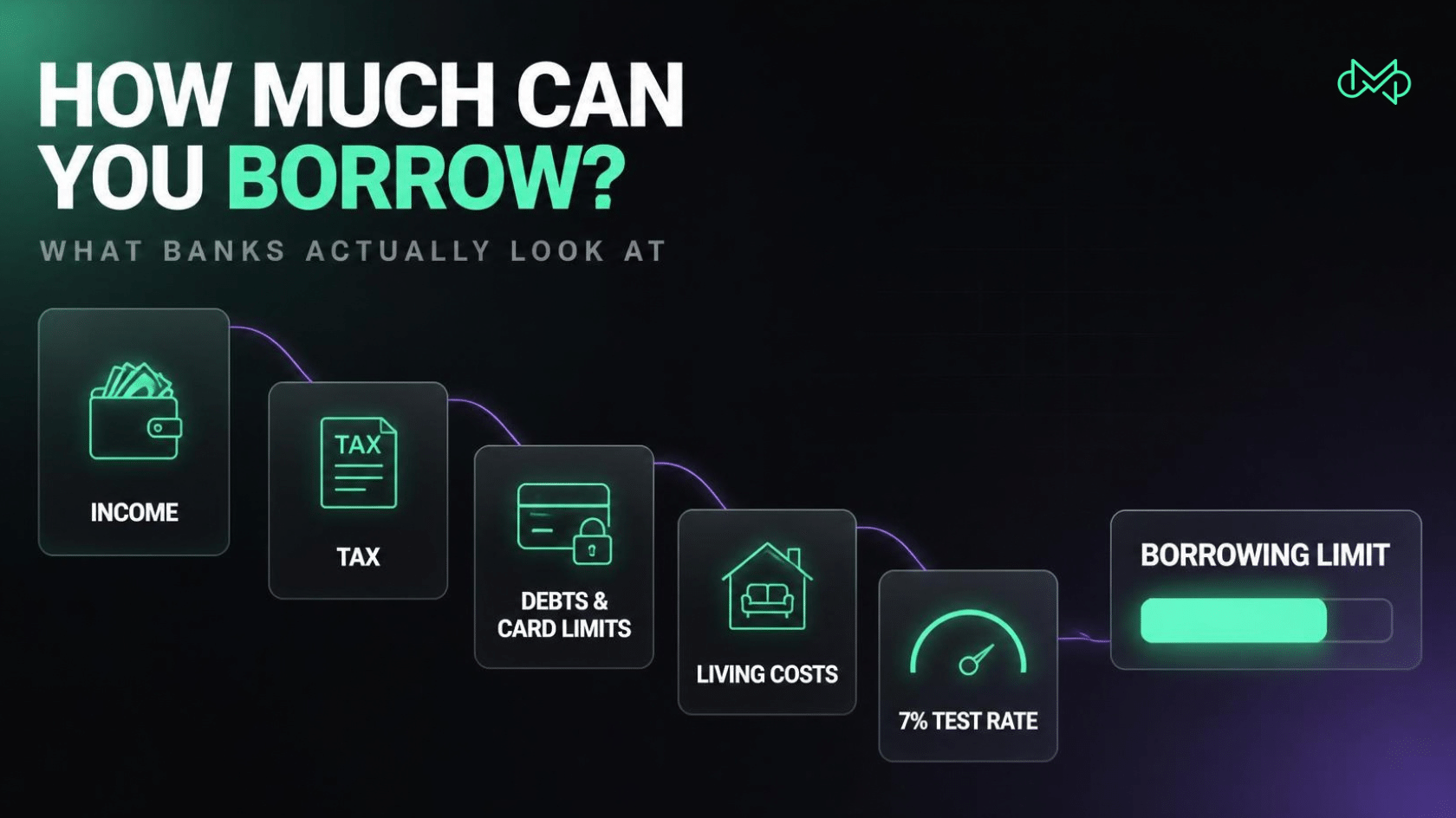
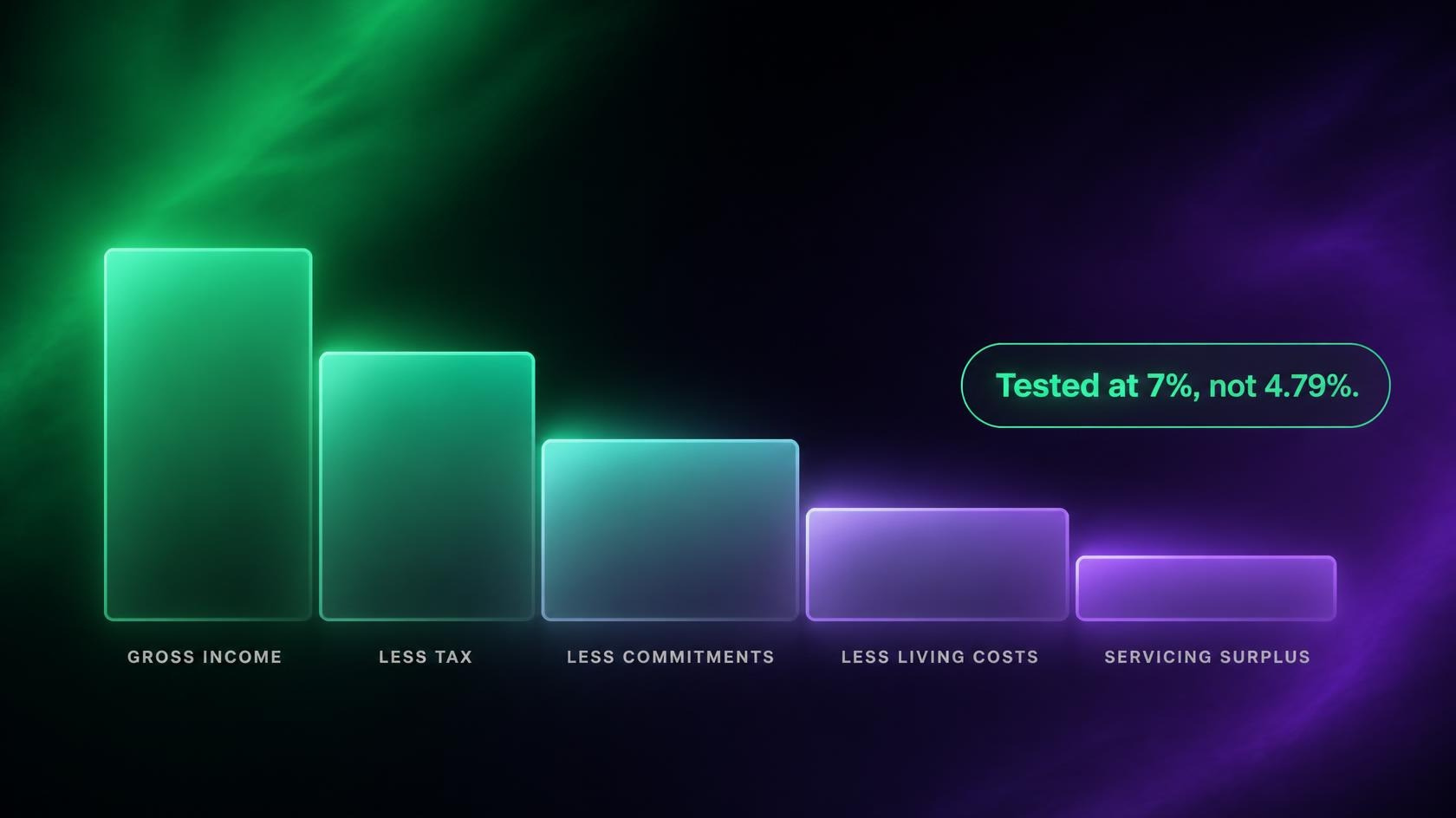
How much can I borrow in NZ? It depends on more than your salary. Most people set their budget by looking at their income. Banks work backwards. They take your income and remove tax. Next, they remove every commitment you already have. Then they remove what they think your household costs to run. Finally, they lend against whatever is left. Then they test the whole thing at an interest rate well above the one you’d actually pay.
That last step catches nearly everyone. Each bank sets its own test rate, and I use 7% on this page as a round example. If your actual rate is 4.79%, a 600,000 dollar loan over 30 years costs about 3,144 dollars a month. At a 7% test rate the bank wants to see you could pay about 3,992 dollars a month. That’s an extra 847 dollars a month, close to 200 dollars a week. You have to prove you could cover it, even though you won’t actually pay it.
For a first home, banks add two more checks on top: where your deposit came from, and what your last few months of bank statements say about your debts and spending.
Base salary is simple. Overtime, commission, bonuses and shift allowances are harder. Most lenders only count part of your variable income. Most also want to see it running for six to twelve months before they count any of it. For self-employed people, lenders usually average income over two years of financial statements. And they use the figure after your accountant has reduced your tax bill.
If you’re on salary or wages, most banks will ask for your latest three payslips. If you’re self-employed, two years of financials is the norm. Some lenders will work with one year if the business is growing strongly. A few will look at a shorter history case by case. Rental and boarder income can count too, but usually only part of it. If you plan to buy soon, hold off on changing jobs until you’re approved. Lenders like stability.
Banks count what you could owe, not what you currently pay. For example, take a credit card with a 10,000 dollar limit and a zero balance. Banks still count it as a monthly cost, even if you never use it. Each lender works that cost out as its own percentage of the limit.
Buy now pay later accounts and overdrafts get the same treatment. Closing cards you don’t use, or cutting their limits, is one of the quickest ways to lift what a bank will lend you.
Student loans are the exception. They behave more like a tax than a debt. There’s no interest while you live in New Zealand, and you repay a fixed percentage of income above the threshold. So a 2,000 dollar balance and a 16,000 dollar balance look almost the same to the bank. That’s why paying down a student loan to borrow more is usually a poor trade. Putting the money into your deposit works better. Car loans, personal loans and hire purchase are the opposite. Clearing those really does move the number.
Banks use a benchmark figure for each adult and each child, then check it against your last three months of bank statements. If you actually spend more than the benchmark, they use your figure.
Dependants move this number more than most people expect. Each child adds a benchmark living cost before the lender even looks at what you spend. So a couple with three children can borrow a fair bit less than the same couple with none. Childcare costs then come on top. Solo parents feel it most, because one income has to cover the benchmark for one adult plus children. It doesn’t mean you should expect a no. It’s the reason two households on the same salaries can get very different answers.
Your deposit decides which lending bracket you fall into. It doesn’t change how much you can service.
Debt-to-income (DTI). On top of servicing, the Reserve Bank’s DTI restrictions limit lending at high multiples of income. Banks can make only 20% of new owner-occupier lending to people whose total debt is over 6 times their gross (before tax) income. For investors, the limit is 20% of new lending above 7 times. Your total debt counts, not just the new mortgage. In practice, banks hold most owner-occupier applications to 6 times. So on a 100,000 dollar household income with no other debt, that’s about 600,000 dollars. For higher earners, DTI usually sets the limit before servicing does. See the table below. New builds and Kāinga Ora First Home Loans are exempt.
Credit history. Your credit record shows lenders how you’ve handled debt in the past. Missed payments, defaults and unarranged overdrafts all get noticed and can narrow your options. You can check your own report for free through Centrix or Experian (which took over illion) before you apply. If something shows up, have a look at our bad credit options before you rule yourself out.
| Deposit | What it usually means | Extra cost |
|---|---|---|
| 5% | A Kāinga Ora First Home Loan through a participating lender, or a new build with a small number of banks | For a First Home Loan, a 1.2% insurance premium on the loan amount, paid upfront or added to the loan, plus any lender fees |
| 10% | Possible with most main banks, but you’re competing for a limited share of their lending | A low equity margin or fee on top of the rate, which depends on the lender and your LVR band |
| 15% | Easier again, with more lenders in play | Usually a smaller low equity margin than at 10% |
| 20% | Standard lending, full rate card, most room to negotiate | None |
Why is it limited under 20%? The Reserve Bank’s LVR rules let banks make up to 25% of new owner-occupier lending to people with under a 20% deposit. For investors, it’s up to 10% of lending with under 30%. Once a bank uses up that share, low deposit lending gets harder to find.
The low equity margin is the part people find out about late. As an example, a pre-approval at 6.79% might be a 6.04% rate plus a 0.75% margin. That’s normal, and it isn’t a mistake on the offer. The margin usually comes off once you’re back under 80%. However, you often have to ask the bank to remove it.
Most first home buyers build their deposit with a KiwiSaver first home withdrawal. Shared home ownership is another route if a standard deposit is out of reach. Some lenders also offer first home buyers cashback or a rate discount, and some offer better pricing on construction lending. None of that changes how much you can borrow, but it can change which lender makes the most sense. There’s more on this in our low deposit home loans guide.
Couple, combined 145,000 dollars, 70,000 in KiwiSaver, 48,000 in savings, no debt, no children. A 118,000 dollar deposit is about 15% on a 780,000 dollar home. With that income and no debt, servicing is comfortable. What holds them back is finding the right house, not the lending.
Single, 95,000 dollar income, 50,000 in KiwiSaver, no savings, 7,000 of debt. The deposit is 50,000 dollars, which is under 10% on any home over 500,000 dollars. Here, a First Home Loan or a new build is often the path. Also, clearing that 7,000 can make a bigger difference than another six months of saving.
The question I get more than any other is some version of “we earn X, we have Y saved, what can we buy?” Nobody in New Zealand publishes a straight answer, so here’s mine, worked through on stated assumptions. These are illustrative examples, not any bank’s figures. Treat them as a starting point, not a number to make an offer on.
| Household income | No debt, no dependants | With a $400/month car loan | What limits it |
|---|---|---|---|
| $80,000 single | about $450,000 | about $390,000 | Servicing |
| $110,000 single | about $660,000 | about $640,000 | DTI, with servicing close behind |
| $145,000 couple | about $870,000 | about $850,000 | DTI |
| $180,000 couple | about $1,080,000 | about $1,060,000 | DTI |
How these were worked out, so you can argue with them. Gross income less income tax at the 2026/27 IRD rates and the 1.75% ACC earners’ levy (a couple’s income split evenly). Then less an assumed living cost of $1,650 a month for one adult or $2,750 for a couple, and a $500 monthly buffer. What’s left is turned into a loan amount at a 7% test rate over 30 years, then capped at 6× income less other debt (the car loan balance is assumed to be $20,000). Rounded down to the nearest $10,000. No dependants, no student loan, and no allowance for a low equity margin if your deposit is under 20%.
This is a general illustration, not personalised financial advice and not a pre-approval. Every lender assesses income, living costs and debt differently. On the same application, the gap between main banks is regularly $100,000 or more. The only number that counts is the one a lender puts in writing for you.
Two things in that table are worth thinking about. At $80,000 the limit is servicing, so clearing debt and cutting fixed costs will move your number. From about $110,000 up, on these assumptions, the limit is the DTI rule, so cutting your spending won’t help. The levers there are income, other debt and deposit. Most people assume they’re in the first situation when they’re in the second, or the other way round.
Your situation won’t match either of those exactly. Send me yours and I’ll run it across the panel before you apply anywhere.
Check what you could borrow →Everything above applies to anyone. First home buyers get a few extra questions on top, and in my experience these are the ones that slow an application down.
The bank wants to see how the money got there. Savings that built up over months are easy. A lump sum that landed three weeks ago will get a question. If family are helping, the bank will want a gift letter saying the money is a gift and not a loan, and some lenders also want to see that you saved part of the deposit yourself. None of that is a problem if the paperwork is ready before you apply.
Most first home deposits include KiwiSaver. You need three years of membership, you have to leave $1,000 in the account, and the money goes through your lawyer. The bank counts it as deposit once your provider confirms what you can take out. I’ve written the KiwiSaver first home rules up separately, because people trip over them more than anything else.
Banks like income that’s settled. If you’re still in a 90-day trial, some lenders will wait until it’s over and others will look past it if you’ve stayed in the same line of work. Switching from salary to contracting just before you apply makes things harder. If you’re thinking about changing jobs, talk to me first. It’s usually easier to buy and then move.
Expect to hand over about three months of statements. The bank is looking for debts you didn’t mention, buy now pay later instalments, bounced payments and regular gambling. I go through exactly what gets flagged in why banks decline home loans.
Under 20%, the rules change: fewer lenders, a low equity margin, often a registered valuation. At 5%, the main route is a Kāinga Ora First Home Loan. I cover both in what changes with a 5% deposit.
This is the piece that explains most of the gap between what you think you can afford and what the bank says. Each bank picks its own test rate. These were the main banks’ rates as reported by interest.co.nz in July 2026:
| Bank | Test rate |
|---|---|
| ANZ | 6.85% |
| ASB | 6.85% |
| Westpac | 6.95% |
| Kiwibank | 6.95% |
| BNZ | 7.10% |
Banks change these without much notice, and the OCR has gone up twice since July, so treat them as a guide rather than a quote. A quarter of a percent on the test rate can move a borrowing limit by tens of thousands.
Answer a few quick questions about your income, deposit and KiwiSaver. I’ll come back to you with what the lenders on my panel are likely to support, before you apply anywhere.
Takes about two minutes. Rather talk? Book a free chat or call 022 064 7770.
How much home loan you can get comes down to three tests, and the lowest result wins. Income: lenders only count the income they accept, after tax. Serviceability: they take off your debts, card limits and living costs, then check the surplus could cover repayments at a test rate well above your real rate (see the table above, around 7%). Debt-to-income (DTI): the Reserve Bank’s DTI restrictions limit how much lending banks can make at high multiples of your gross income, and in practice most owner-occupier loans are held to about 6 times income, as covered above.
There is no single multiple that fits everyone. A rough rule of thumb is that most people can borrow somewhere up to about six times their household income, but a car loan, a few credit card limits or two children can pull that number down well below it. The illustrative table above shows where each limit bites. The same applies whether you’re asking how much mortgage loan or housing loan you can get: the lender’s rules decide, not the label.
Want a quick estimate first? Try our borrowing and mortgage calculators, then book a free chat so I can check your numbers against real lender policy.
Want a number to start with?
Use the mortgage calculator →Online calculators run one lender’s model on the numbers you type in. They don’t know your overtime has been running for eight months rather than fourteen. They don’t know about limits on your KiwiSaver withdrawal. And they don’t know that one lender counts boarder income while the next one doesn’t.
On the same application, the gap between the most and least generous main bank is regularly 100,000 dollars or more. That’s a real difference. It’s the main reason I always check more than one lender before deciding what you can afford.
Our borrowing calculator NZ (and the wider mortgage calculators) are fine for a rough starting point. They can’t replace someone checking your file against actual lender policy.
The rules on this page that are set by the government or the regulator change from time to time. The figures here were checked on 9 October 2026. Check the current position at the source.
The full guide, from the first conversation to getting the keys.
How lenders treat existing debt, and when rolling it into a mortgage helps.
What lenders accept as income when you don’t have payslips.
What’s possible at 5% and 10%, and what it costs.
Why the bank that lends you the most isn’t always the one with the best loan.
Repayments, borrowing power and deposit.
The rules buyers get wrong, and how the timing works.
What happens after you find a house, step by step.
Send me your income, your debts and what you’ve saved. I’ll tell you what the panel supports and which lender is likely to lend you the most, before you apply anywhere.