

5% Deposit Home Loans: What Actually Changes When You Have Less Than 20%?
You can buy with a 5% deposit in New Zealand, but fewer doors are open and it costs more. Under 20%, banks ration their lending under the Reserve Bank’s LVR rules, most add a low equity margin or fee, they usually want a registered valuation, and they look harder at your income and spending. At 5%, the main route is a Kāinga Ora First Home Loan, which has income caps and a 1.2% insurance premium. A few banks also do their own 5% lending.
Every lender works this out differently. Treat it as a guide, not a guarantee.
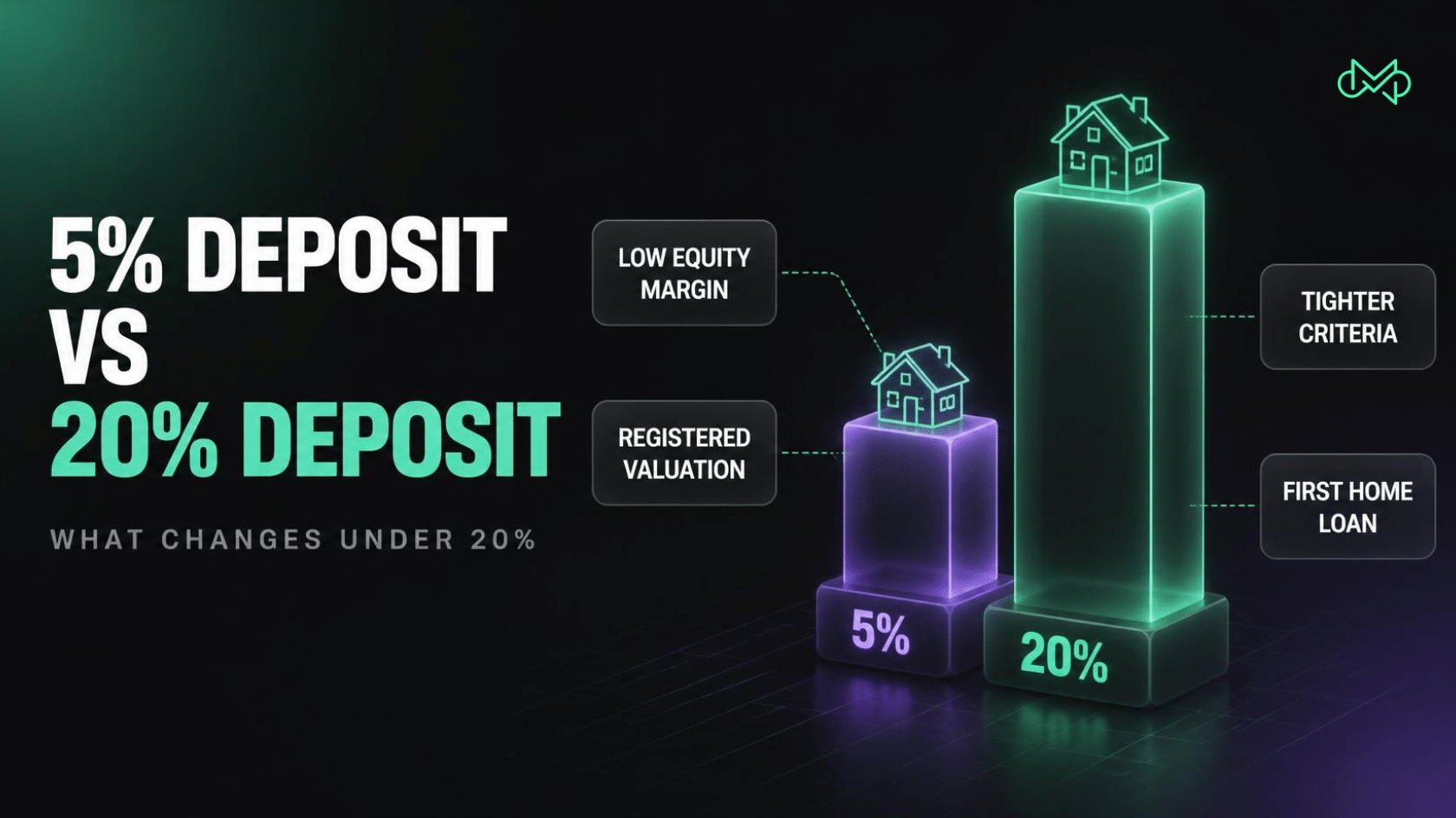
A year ago, buying with a 5% deposit felt like a long shot. Since the Reserve Bank eased its LVR rules, more first home buyers are doing it, and in some months over half of first home lending has gone to people with less than 20%. So it’s possible. The question is what changes when you do it, and whether it’s the right move for you.
Why 20% is the line
The Reserve Bank’s LVR rules limit how much banks can lend to people with small deposits. Since 1 December 2025, banks can make up to 25% of their new owner-occupier lending to buyers with less than a 20% deposit. That was confirmed again in August 2026.
So low deposit lending is rationed, not banned. Each bank decides how much of that 25% it wants to use and who gets it. That’s why one bank can say no to a 10% deposit and another says yes the same week.
Two things sit outside those limits: Kāinga Ora First Home Loans, and lending on new builds. That’s why both come up so often when deposits are small.
What changes at 20%, 10% and 5%
| 20% or more | 10% to 19% | 5% to 9% | |
|---|---|---|---|
| Who lends | Every bank | Most banks, within their LVR allowance | Mainly First Home Loan lenders, a few banks, new builds |
| Extra cost | None | Low equity margin or fee | Bigger margin, or the First Home Loan’s 1.2% premium |
| Valuation | Sometimes | Usually a registered valuation | Usually a registered valuation |
| Criteria | Standard | Tighter | Tightest, with income caps on the First Home Loan |
| Rate specials and cashback | Full access | Varies by bank | Varies, some banks still pay cashback |
5% deposit calculator
Enter a house price and the deposit you have, including KiwiSaver and any gift. This is a general guide, not an ASB or lender calculator.
The low equity margin, in dollars
Most banks add a margin to your interest rate when your deposit is under 20%. It’s charged in bands, so it shrinks as your deposit grows. BNZ publishes its rates, which makes it a useful example:
| Deposit | Loan-to-value (LVR) | Premium a year |
|---|---|---|
| 15% to 20% | 80.01% to 85% | 0.35% |
| 10% to 15% | 85.01% to 90% | 0.75% |
| 5% to 10% | 90.01% to 95% | 1.20% |
| Under 5% | Over 95% | 1.50% |
Other banks do it their own way. Westpac adds a margin in similar bands. ASB has a margin but doesn’t publish the amounts, and you can ask for a review after six months. ANZ charges a one-off fee. Kiwibank doesn’t add a margin, but you pay its standard rates rather than its specials.
Here’s what that looks like on a $700,000 home, using an example rate of 5.00% over 30 years:
- 20% deposit ($140,000): a $560,000 loan, about $3,006 a month.
- 5% deposit ($35,000) at 5.00%: a $665,000 loan, about $3,570 a month.
- 5% deposit with a 1.20% margin (6.20%): about $4,073 a month.
The margin alone adds about $500 a month in that example, and you’d be tested at the bank’s test rate on the bigger loan as well. That’s the real trade-off. The question I ask clients is whether that extra cost is less than what they’d spend in rent, and lose in price movement, while they save the rest.
The Kāinga Ora First Home Loan
For most people with 5% to 10% saved, this is where I start. The bank lends the money and Kāinga Ora underwrites it, which is why it sits outside the LVR and DTI limits.
- Deposit: at least 5%. KiwiSaver counts.
- Income caps (before tax, over the last 12 months): under $95,000 for a single buyer, under $150,000 for a single buyer with dependants, under $150,000 combined for two or more buyers.
- Cost: a 1.2% insurance premium on the loan amount, paid upfront or added to the loan. On a $665,000 loan that’s $7,980.
- Lenders: ASB, Westpac, Kiwibank, the Co-operative Bank, SBS, Unity, Nelson Building Society and NZHL. ANZ and BNZ don’t offer it.
- Who: NZ citizens and residents, 18 or over, buying a home to live in. Previous owners can sometimes qualify.
ASB joined the scheme in February 2026, doesn’t add its low equity margin to First Home Loans, and its usual first home cashback can apply. That combination has made it worth comparing closely. There’s more detail on my First Home Loan page.
ASB 5% deposit home loans
If you searched for an ASB home loan calculator, the calculator above gives you the deposit percentage, loan size and an indicative repayment. ASB’s own online calculators are on its website, and ASB’s official numbers will always win over ours.
For a 5% deposit, ASB is one of the participating lenders in the Kāinga Ora First Home Loan, so the scheme’s rules apply: at least 5% deposit, the income caps above, and the 1.2% premium. ASB still assesses your income, spending and the property under its own lending criteria. Its policy, rates and any cashback change often, so I won’t quote them here. Check ASB’s current offer, or book a free chat and I’ll compare it with the other lenders for your situation.
What the bank looks harder at
The property
Expect a registered valuation. If it comes in under the price, your deposit shrinks as a percentage and the deal can fall over. Some properties need a bigger deposit whatever your income: small apartments, leasehold, some cross-leases and homes with weathertightness questions. Check before you fall in love with one.
Your servicing
A bigger loan means bigger repayments at the test rate. If your numbers were tight at 20%, they’ll be tighter at 5%. Clearing a car loan or cutting card limits often matters more here than saving another few thousand. My guide to how much you can borrow shows how banks run that test.
Your deposit and your statements
With less of your own money in, banks look closely at where the deposit came from and how you manage money. Three clean months of bank statements, with no bounced payments or stacked buy now pay later, makes a real difference. I cover what they flag in why banks decline home loans.
New builds
New builds sit outside the LVR rules, so some banks will go to 10% or lower on a new home bought off the plans or from the builder. Construction lending has its own risks and paperwork. If you’re looking at house and land packages, talk to me before you sign the build contract.
Is it worth buying with 5%?
Sometimes yes, sometimes no, and I’d be wary of anyone who gives you a flat answer. If the repayments are comfortable at the bank’s test rate, you’ve got some buffer left after settlement, and you’re planning to stay at least five years, buying with 5% can make more sense than renting for three more years to reach 20%.
The risk is selling early. With only 5% equity, a small dip in prices can leave you owing more than the home is worth. That only really bites if you have to sell, but it’s worth thinking through before you sign.
Common questions
Can I buy a house with a 5% deposit in NZ?
Which banks offer 5% deposit home loans?
What is a low equity margin?
Can I get the low equity margin removed?
Do I need a registered valuation with a low deposit?
Is a 5% deposit loan a good idea?
Not sure which low deposit route fits you?
Tell me your deposit, income and where you’re at. I’ll come back with which lenders are likely to say yes and roughly what it would cost.
Takes about two minutes. Rather talk? Book a free chat or call 022 064 7770.
Where these rules come from
Checked on 9 October 2026. Lender pricing and policy change often, so confirm the current position before you rely on it.
- Reserve Bank of New Zealand, LVR settings maintained (August 2026)
- Kāinga Ora, First Home Loan brochure
- Kāinga Ora, First Home Loan insurance premium
- BNZ, low deposit home lending
- ASB, First Home Loan
Read next
Low deposit home loans
All the routes into a home with a small deposit.
Using KiwiSaver for a first home
The rules buyers get wrong.
How much can I borrow?
What banks actually look at.
Talk it through with Yatin. Free, no obligation, and usually one phone call.
Book a free chat →Or call 022 064 7770
This article is general information only and isn’t personalised financial advice. It doesn’t take account of your objectives, financial situation or needs, figures are indicative, and all lending is subject to each lender’s criteria. Mortgage Sense is a trading name of Yatin Kainth, a Financial Adviser (FSP1007497) providing advice under the Mortgage Managers licence (North West Group Holdings Ltd, FSP682791). Read our Disclosure Statement, fees and how we are paid, how to make a complaint and Privacy Policy.
Ready to talk it through?
Get mortgage advice NZ homeowners actually trust. Book a free, no-pressure chat with Yatin.
Book a free chat →