Mortgage Broker for Investment Property Loans — New Zealand
Investment Property Lending for New Zealand Property Investors
Build long-term wealth through property. We help investors access suitable lending and structure portfolios strategically — from your first rental to portfolio growth.
Many first-time investors keep all borrowing with one bank — and for some situations, this works well. However, as investment portfolios grow, experienced investors often consider spreading lending across multiple lenders for greater flexibility.
Every buyer’s situation is unique. Your income, savings, employment history, and existing lending all matter. Our job is to understand where you are and map out a realistic path forward.
You don’t need a certain deposit amount. You don’t need perfect credit. You need the right advice and a strategy that suits your circumstances. As an experienced mortgage broker for investment property lending, that’s exactly what we provide.
Experienced Investment Property Adviser
We work with investors at every stage — your first rental property, portfolio expansion, or restructuring. We understand how lenders assess investment applications and what strengthens your position.
Access to Multiple Specialist Lenders
We compare lenders experienced in supporting property investors. Different lenders have different lending preferences and appetite for investment properties. We help identify which ones suit your situation.
Accurate Rental Income Assessment
Lenders typically recognise a proportion of rental income (often 70–80%, though this varies). We calculate this accurately so you understand your real borrowing capacity and avoid surprises later.
Portfolio Strategy, Not Just One Loan
Whether you’re buying your first rental or growing a portfolio, we help you think strategically about equity positioning, loan structure, and long-term growth — not just securing a single loan.
How It Works
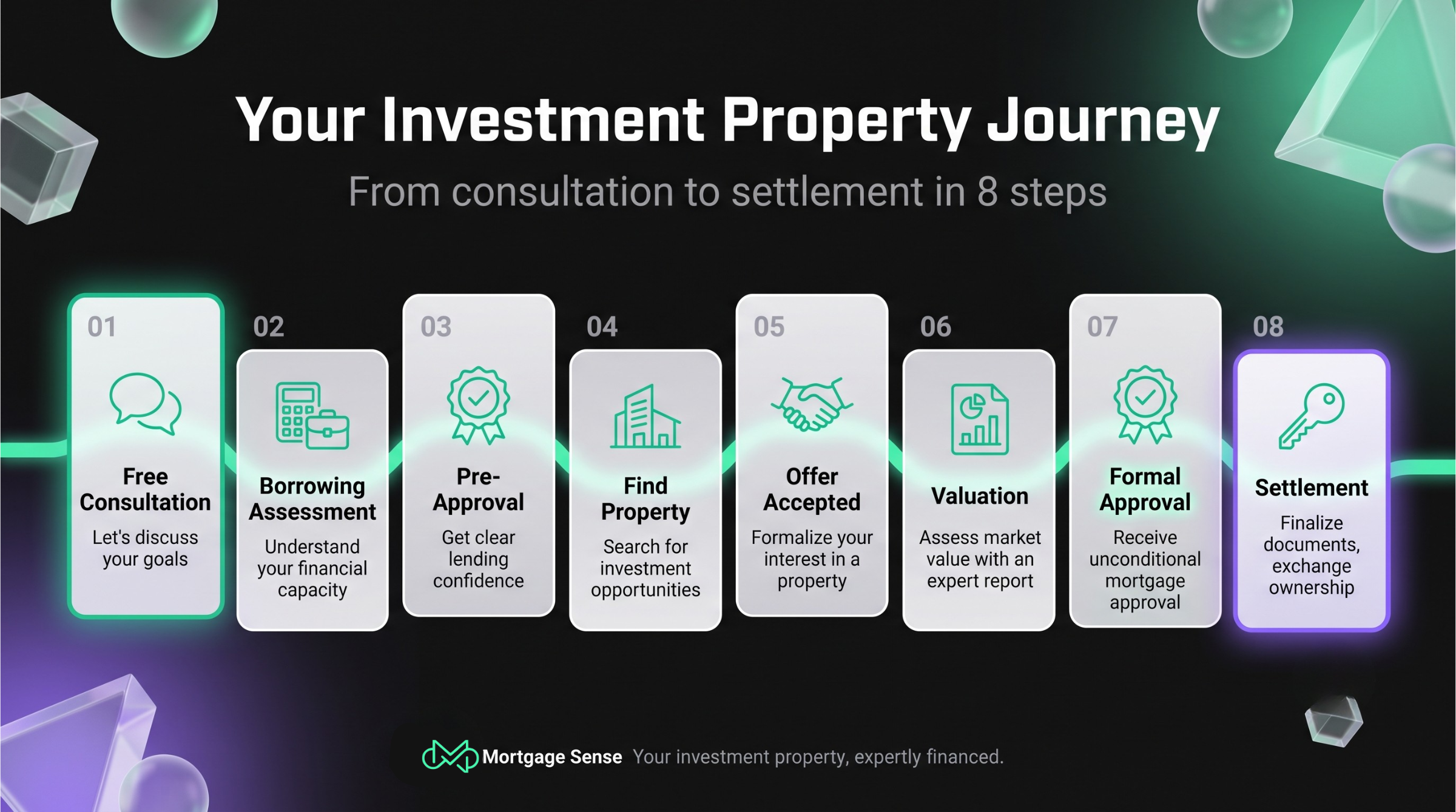
The Investment Lending Journey, Step by Step
Most investors have questions about the lending process. Here’s the complete journey from deciding to invest through to settlement.
01
Assess Your Position
We review your current equity, existing mortgage, and available funds to understand your starting position realistically. This determines what’s achievable and what preparation might be needed.
02
Review Rental Income
For properties you already own, we assess actual rental income and how lenders typically view that income for servicing calculations. Lenders generally don’t count 100% of rental income.
03
Identify Suitable Lenders
Once you’ve identified a property, we begin preliminary conversations with lenders experienced in investment property lending. Different property types suit different lenders.
04
Obtain Pre-Approval
We prepare your application, compare lender options, and work towards pre-approval for the investment property. This typically takes 5–10 business days once documents are complete.
05
Make an Offer
You make an offer conditional on finance approval and a building inspection. These conditions protect you if the lender declines or if structural issues emerge during inspection.
06
Valuation & Formal Approval
The lender arranges a valuation and assesses the specific property. We manage this communication. Formal approval typically takes 5–10 business days from receipt of valuation.
07
Settlement
Your lawyer manages settlement. We ensure you understand your loan terms, structure, and ongoing obligations before settlement day.
Core Concepts
Investment Lending Essentials
Understanding how lenders assess investment property applications helps you build a stronger position and know what to expect.
🏠Rental Income Recognition
Lenders typically recognise between 70–80% of rental income as serviceability (though this varies between lenders and their specific assessment approach). This accounts for periods of vacancy, maintenance costs, and general market variability.
For example, a property renting at $500 per week might be assessed by one lender at $350–400 per week for serviceability purposes. We calculate this accurately for your specific situation so you understand your real borrowing capacity.
📊Household Serviceability Assessment
Lenders assess your ability to service the investment loan alongside your personal living expenses and existing commitments. They typically review your total household income (personal income + recognised rental income), assess your living expenses and existing financial commitments, stress-test the investment loan repayment at rates higher than your current rate, and confirm you can service the loan under a range of scenarios.
This assessment differs between lenders — each has its own approach to servicing calculations and stress-testing. We help ensure your application presents your financial position clearly.
📈Loan-to-Value Ratio (LVR)
LVR describes how much you’re borrowing compared to the property value. Around 70% LVR generally provides access to the widest range of lenders and competitive pricing. Around 80% LVR is a common lending level for investors; may have additional costs or margin depending on the lender. Above 80% LVR may be available in limited circumstances, but typically involves fewer lenders and stricter requirements.
Your specific LVR, combined with your overall financial position, affects the lenders willing to support you and the pricing they offer.
💼Employment & Income Stability
Lenders want to see stable personal income as a foundation, even when rental income contributes towards serviceability. Your employment or self-employment income provides continuity and demonstrates your capacity to service the loan if rental income circumstances change.
🏢Property Type & Location
Lenders have different preferences for investment property types. Some focus on residential rentals in main urban centres; others have experience with commercial, rural, or specialist properties. We understand which lenders are experienced with different property types and can guide you accordingly.
✓Credit History & Financial Conduct
Lenders review your credit history and payment patterns. A clean credit file and consistent payment history across personal and investment lending strengthens your application. We advise on how to present your financial conduct clearly.
Structure & Strategy
Choosing a Structure for Your Investment Property
Structuring decisions have tax and legal implications beyond lending. Always consult your accountant about the right structure for your circumstances before we prepare your application. We work with your accountant to ensure the structure supports both your lending position and overall financial plan.
Personal Name
Simplest structure to set up and maintain
Most lenders have straightforward processes for personal lending
Interest may be tax-deductible, depending on current tax legislation — speak with your accountant
You hold the property and loan liability personally
Best for: First rental property, straightforward investment situations
Company Structure
More complex to set up and operate
Provides limited liability for the loan
Tax treatment can be relevant, but requires specialist advice
Some lenders have specific requirements or different terms
Best for: Larger portfolios where liability management is a priority
Trust Structure
Common in NZ property investing for wealth planning
Trust deed complexity varies; lenders may require specific documentation
Offers flexibility in how income and gains are distributed
Some lenders have stricter criteria or require longer trust history
Best for: Multi-property portfolios and long-term wealth planning
Feature
Personal
Company
Trust
Simple to establish
✓
Moderate
Moderate
Common for first investment
✓
—
—
Requires accountant
Recommended
✓
✓
Asset protection considerations
Limited
✓
✓
Separate legal entity
—
✓
✓
Lender complexity
Low
Moderate
Moderate
Loan Structure
Interest-Only vs Principal & Interest
Choose the loan structure that matches your investment goals and cash flow strategy.
Interest-Only Loans
Lower repayments during the interest-only period
Interest may be tax-deductible (speak with your accountant)
The loan principal doesn’t reduce
Interest-only rates may be higher than P&I products
Suits investors focused on cash flow and capital growth
⚠ Plan ahead — repayments will increase significantly when the interest-only period ends (typically after 5–10 years).
Principal & Interest Loans
You reduce the loan balance with each payment
Interest may be tax-deductible (speak with your accountant)
Repayments are higher than interest-only
Building equity continuously
After the loan term, you own the property outright
💡 Provides more certainty about long-term debt reduction and building equity faster.
Blended Strategy Often Works Best
Many investors structure part of their investment loan as interest-only (for cash flow) and part as principal & interest (for equity building). We help you explore what structure suits your situation.
Our Advantage
Why Choose Mortgage Sense for Investment Lending
As a specialist investment property mortgage broker, we provide more than just loan applications. Here’s what that looks like in practice.
🎯
Specialist Investment Knowledge
We understand investment lending, rental income assessment, portfolio positioning, and what different lenders look for. We help you think beyond a single loan towards long-term portfolio strategy.
🏦
Access to Specialist Lenders
We work with lenders who actively support property investors. Different lenders suit different situations — we help identify the right fit for your circumstances.
📊
Accurate Financial Assessment
We calculate rental income recognition, assess serviceability carefully, and ensure you understand your real borrowing capacity. No guesswork — just clear numbers.
⚖️
Guidance on Investment Structure
We explain how different structures (personal, company, trust) affect your lending position. We don’t provide tax or legal advice, but we work alongside your accountant and lawyer to ensure structure and lending align.
📈
Portfolio-Focused Thinking
Whether buying your first investment property or your fifth, we think about equity positioning, loan structure, and growth strategy — not just closing individual loans.
🤝
Support Through the Process
We help you understand your loan terms, manage the process from pre-approval through settlement, and plan for future property purchases and portfolio refinancing.
Strategic Lending
Spreading Investment Lending Across Multiple Lenders
Many first-time investors keep all borrowing with one bank — and for some situations, this works well. However, as investment portfolios grow, some investors consider spreading lending across multiple lenders for greater flexibility.
Independent Securities
Each property stands on its own security with separate lenders.
Greater flexibility as your portfolio grows
You maintain more control over individual properties
Refinance one property without affecting others
Release equity from one property independently
Sell a property without lender approval across portfolio
Cross-Collateralised Portfolio
Multiple properties are used as security for the same facility.
One lender controls all available equity
Selling one property may require lender reassessment
Accessing equity becomes more complicated
Refinancing a single property may be difficult
One lender has greater control over entire portfolio
💡 Investor Tip
Where appropriate, we often look at structuring lending so each property stands on its own security rather than automatically cross-collateralising. This can provide greater flexibility for future refinancing and portfolio growth. However, every situation is different — some lenders prefer cross-security, and some investors prefer the simplicity. The most appropriate structure depends on your individual circumstances and lending objectives.
Real Scenarios
Examples of Investment Property Journeys
These are illustrative examples based on common scenarios, not actual clients. Individual circumstances vary significantly. All lending is subject to individual lender assessment, credit criteria, and approval.
First Investment Property
Saved steadily — Ready to invest
Situation
Home owner with $150k equity. Stable income. Identified rental property.
↓
Challenge
Uncertain about borrowing capacity. First time managing investment finances.
↓
Mortgage Sense Solution
Assessed serviceability, calculated rental income recognition, compared suitable lenders, structured loan separately from residential mortgage.
↓
Outcome
Clear understanding of borrowing capacity and loan structure. Purchased investment property with confidence in cash flow.
Portfolio Growth
Expanding to third property
Situation
Two rental properties, residential mortgage. Strong rental income. Wants third property.
↓
Challenge
Original lender becoming conservative about overall debt levels. Limited capacity for another loan.
↓
Mortgage Sense Solution
Worked with specialist lenders experienced in portfolios. Restructured lending across multiple lenders. Presented overall portfolio position.
↓
Outcome
Access to competitive terms across portfolio. Portfolio growth plan progressed without hitting lending constraints.
Existing lender reluctant to improve rates. Limited capacity for new lending.
↓
Mortgage Sense Solution
Refinanced with new lender at better rates. Repositioned portfolio across two lenders. Optimised pricing and capacity for next purchase.
↓
Outcome
Improved interest costs on existing debt plus capacity to acquire next property without waiting to save more deposit.
Budget Planning
Investment Property Costs: What to Budget
Beyond the deposit, understand the full cost of purchasing and managing an investment property.
Purchase Costs (One-time)
Legal and conveyancing fees$1,200 – $2,500
Building inspection$500 – $1,000
LIM report$250 – $400
ValuationUsually lender-arranged
Ongoing Annual Costs
Mortgage paymentsVariable
Council ratesVariable
Home and contents insurance$1,000 – $2,500/year
Maintenance and repairsVariable
Property management (if outsourced)Usually 7–10% of rent
Illustrative Example Budget
Purchase Price$600,000
Deposit (15%)$90,000
Legal Fees$1,800
Building Inspection$700
LIM Report$300
ValuationLender-arranged
Contingency$2,000
FAQ
Investment Property Lending Questions Answered
Everything property investors ask us — answered clearly and honestly.
Borrowing capacity depends on your total household income, living expenses, existing commitments, and how lenders assess your serviceability. Rental income contributes (typically recognised at 70–80%, though this varies), but personal income provides the foundation. Each lender has its own assessment approach. We calculate your specific borrowing capacity based on your complete financial picture and compare options across suitable lenders.
Most lenders prefer higher equity for investment properties than owner-occupied properties. Common lending levels sit around 70–80% LVR (meaning 20–30% deposit), though this varies by lender and your overall position. Lending above 80% LVR may be available in limited circumstances, but usually involves fewer lenders and stricter requirements. We help you understand what deposit position works for your situation and goals.
Investment property rates vary between lenders and depend on your LVR, loan structure, credit history, and market conditions. We negotiate on your behalf to identify the most competitive terms available for your circumstances.
Interest on money borrowed to invest in property may be tax-deductible. Tax treatment depends on current legislation and your specific circumstances. Speak with your accountant about what’s deductible in your situation — tax law is complex and changes periodically.
When the interest-only period expires (typically after a set period, often up to around five years, sometimes longer, depending on the lender and your circumstances), your loan converts to principal & interest, and repayments increase significantly. You should plan for this from day one. Some investors refinance before the interest-only period ends; others manage the higher repayment. We help you understand the implications and plan accordingly.
Yes — many investors use home equity to fund investment property purchases. This is a significant financial decision because you’re using equity from your primary residence. Speak with us, or a financial adviser, about whether this strategy suits your circumstances and risk tolerance.
You remain responsible for the full loan amount, regardless of property value changes. A temporary decline in value doesn’t typically trigger lender action unless it significantly affects your LVR or servicing position. Speak with us about how market changes might affect your position.
Lenders typically recognise a proportion of rental income (commonly 70–80%, though this varies by lender). This accounts for vacancy, maintenance, and market variability. We calculate this accurately so you understand the real contribution to your borrowing capacity.
Each structure has different lending, tax, and legal implications. Personal ownership is simplest but offers no liability protection. Company and trust structures offer different benefits but require higher equity and involve more complexity. Speak with your accountant and lawyer about the right structure before we prepare your application. We work alongside your advisers to ensure the structure supports both lending and your overall financial plan.
Pre-approval typically takes 5–10 business days once your documents are complete. Formal approval after you’ve made an offer usually takes 5–10 business days following valuation. Settlement timelines vary but typically occur 8–12 weeks after the offer, depending on conveyancing and other factors. We keep you informed at every stage.
Still Have Questions?
We’re here to help. Every investor’s situation is different, and we’re happy to discuss your specific circumstances and investment goals in detail.
“Yatin helped us understand our portfolio position and identified a lending strategy that gave us way more flexibility than keeping everything with our bank. His knowledge of investment lending made a real difference.”
Sarah
Auckland, NZ
Get Started
Ready to Grow Your Investment Property Portfolio?
Whether you’re buying your first investment property or scaling your portfolio, Mortgage Sense is here to help you access suitable lending and structure your investments strategically.