Looking to refinance your mortgage? We help NZ homeowners refinance their mortgage to save on interest, access equity, or consolidate debt โ finding the right strategy for your situation.
Refinance your mortgage in New Zealand to reduce interest payments, access equity, or consolidate high-interest debt. We work with 30+ lenders to find the right refinancing solution for your situation.


Refinancing your mortgage is easier than many homeowners think. The mortgage landscape changes constantly. Importantly, even if you haven’t switched lenders recently, your refinancing opportunities may have improved significantly โ and you might not realise it.
Notably, lenders update their serviceability rules and assessment criteria regularly. As a result, a lender that said no two years ago might say yes today.
Over time, your home builds equity. In effect, that equity is an asset โ and refinancing lets you access it for renovations, investments, or debt consolidation.
Salary increases, improved credit scores, and career advancement change your borrowing capacity. Consequently, better finances often unlock better lending terms.
The only way to know whether refinancing makes sense is to get a professional assessment.

When you refinance your mortgage, you have multiple options. Here’s what’s possible: Here are the main reasons homeowners refinance โ and how each one can work for your situation.
Even a small rate drop compounds significantly over decades. Therefore, we compare 30+ lenders to find your best available rate.
Monthly savings of $300โ$500 can make a real difference to cashflow. In turn, that freed-up income funds your priorities.
For instance, you can use released equity for renovations, investment, education, or debt consolidation at more favourable rates than personal loans.
Essentially, you roll high-interest personal loans and credit cards into your mortgage at a more favourable rate. As a result, you have one payment and one lender.
Generally, mortgage lending offers better rates than specialty renovation finance. Ultimately, you improve your home at competitive cost.
Refinance your primary residence to release equity for your next investment purchase.
For example, you can switch IO to P&I, split your loan for flexibility, or adjust your term. Indeed, refinancing is the ideal time to reshape your strategy.
Multiple mortgages scattered across lenders? Consolidate into one loan, one payment, one relationship. Clarity builds confidence.
The good news: many homeowners may be eligible to refinance. Here’s how different situations are typically assessed.
Generally, stable employment strengthens your application. As such, refinancing is often faster for PAYE borrowers, subject to lender assessment.
Admittedly, more documentation is required (tax returns, GST, P&L). However, many self-employed borrowers refinance successfully.
Similarly, investment properties refinance regularly. We know which lenders specialise in investor portfolios.
Refinancing may be possible, though with stricter criteria. Notably, lender policies vary significantly โ individual assessment is essential.
Importantly, past difficulties don’t necessarily disqualify you. Moreover, we work with lenders experienced in assessing various credit histories.
A common refinancing trigger. Plan ahead โ refinancing is the ideal time to transition smoothly.
Typically, recently completed properties can be refinanced once settled.
Unique circumstances are exactly when professional guidance helps most. Get in touch for an individual assessment.
Approximately 4โ8 weeks from assessment to settlement. Often faster than your original mortgage application.
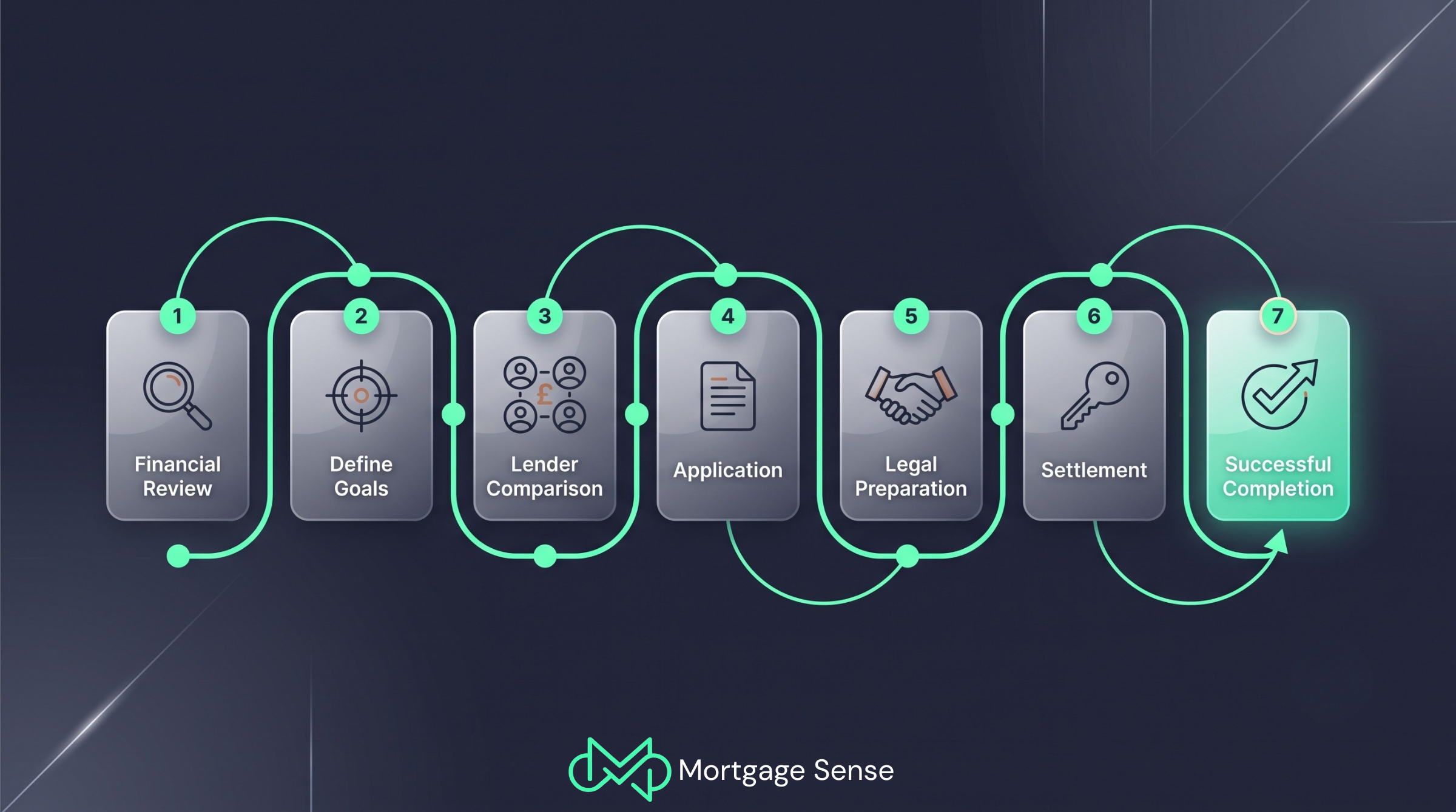
First, we assess your current balance, rate, term, equity, and financial circumstances. Typically this takes 1โ2 days and is free.
Lower rate, equity access, debt consolidation, IO-to-P&I restructure? Clear goals drive every decision that follows.
We submit your application to the most suitable lenders. The lender reviews your financial position and may request additional documents or a property valuation. Timeline: 5โ10 business days.
The lender issues conditional approval, confirming the loan amount, rate, and terms available to you. Any outstanding conditions (e.g. valuation, insurance) are satisfied before proceeding. Timeline: 3โ7 business days.
Next, lawyers prepare discharge of old loan and new loan documentation. We manage timing to minimise interest overlap. Timeline: 1โ2 weeks.
Finally, the new lender pays off your old loan. The new loan is then registered against the property. Refinancing is complete. New terms begin immediately.
Confirm new terms, set up payments, plan next steps โ equity use, investment timing, debt payoff acceleration.
If your current rate is 1% or more above market rates, refinancing usually makes financial sense. Calculate savings minus costs to confirm net benefit.
20%+ equity unlocks genuine refinancing benefits. Access cash at better rates than personal loans or credit cards โ if you’ll use it wisely.
Consolidating into your mortgage at a more favourable rate often makes sense โ if you commit to not re-accumulating the debt.
A salary increase lets you afford higher repayments. Refinancing to a shorter term builds equity faster and reduces total interest paid.
IO period ending, or want to split your loan? Refinancing lets you restructure to match your goals. Plan ahead for repayment changes.
Improved credit, bonus, promotion? Better circumstances often unlock better lending terms. A review confirms what’s now possible.
โ ๏ธ When to hold tight: Refinancing costs exceed savings over your remaining loan term ยท You’re close to paying off your current loan ยท Planning to sell within 2โ3 years ยท Breaking a fixed rate would incur significant penalties.
Additionally, refinancing is often the perfect time to consolidate personal loans, credit cards, or vehicle loans into your mortgage.
Personal loans, credit cards, vehicle loans, and BNPL debt can all be consolidated when you refinance.
Notably, mortgage lending carries significantly lower interest rates than unsecured debt. As a result, you get one payment, greater clarity, and faster payoff.
Crucially, you’re converting unsecured debt into a secured debt โ meaning your home becomes security. Without addressing spending habits, you’ll re-accumulate credit card debt while owing a larger mortgage.

The following refinance mortgage examples are illustrative and based on common NZ scenarios. Individual results vary. Subject to lender assessment and individual circumstances.
Situation: Fixed rate expired; market conditions had improved roughly 1.5% below their existing rate.
Outcome: Refinanced successfully. Monthly repayments reduced materially. Total refinancing costs recovered in under 3 months. Substantial interest saved over the loan term.
Situation: Substantial equity across two properties; needed capital for an investment property without selling.
Outcome: Refinanced primary property to access equity. Restructured across two lenders. Investment property purchased. Portfolio expanded with separate securities maintained.
Situation: Home loan plus high-interest credit card debt across multiple cards draining cashflow.
Outcome: Consolidated all credit card debt into mortgage at significantly more favourable rates. Single payment, materially improved cashflow, accelerated debt payoff.
NZ refinancing strategies, timing, lender policies and optimal structures โ not just loan applications.
We compare across 30+ lenders to find you the best available terms for your situation.
Every cost explained upfront. You know exactly what you’re paying and why โ no surprises at settlement.
We streamline the refinancing process. Pre-approval in as little as 5โ10 business days.
We negotiate with lenders on your behalf, compare options, and help secure competitive terms. You focus on the decision.
We assess whether consolidation is right for you, structure it correctly, and support you beyond settlement.
After refinancing, we help plan future equity access, investment properties, or debt freedom. Relationship-based.
If refinancing doesn’t make sense for you, we’ll tell you honestly. Your long-term benefit is our priority.
When deciding whether to refinance your mortgage in NZ, compare these key factors side by side.
| Feature | Staying With Current Lender | Refinancing โ |
|---|---|---|
| Interest Rate | Current rate (subject to lender review) | Competitive market rates available |
| Monthly Repayments | Unchanged unless lender adjusts | Likely lower (if rates have dropped) |
| Access to Equity | Limited; must ask current lender | Flexible; can refinance to access |
| Loan Structure | Limited restructuring options | Full flexibility (IO, P&I, splits) |
| Lender Choice | Restricted to your current lender | 30+ lenders to choose from |
| Ongoing Review | Limited unless you initiate | Proactive review and optimisation |
| Long-Term Savings | Limited unless lender improves terms | Optimised rates + structure = larger savings |
A free assessment shows you exactly what’s possible for your specific situation.
Refinancing only makes sense if the interest savings outweigh the costs. Here’s how to think about it.
If refinancing doesn’t make financial sense, we’ll tell you honestly. Your long-term benefit is our priority โ not commission.
Indicative only. Your actual savings depend on rate available, costs, and remaining term.
Indicative only โ actual savings depend on the rate available, refinancing costs, and your loan term.
Indicative only โ not financial advice. For your personalised assessment, book a free review.
Generally, with fixed-rate loans, you refinance when the fixed term ends โ no break fees apply. By contrast, floating-rate loans can be refinanced anytime. If you have a hybrid loan (part fixed, part floating), each portion ends at a different time. Plan ahead โ don’t wait until your fixed rate is about to expire.
If you refinance before your fixed rate expires, your lender charges a break fee โ their cost of unwinding the interest rate swap they entered. Break fees can be substantial (sometimes significant five-figure amounts). The key question: Is the interest saving worth paying the break fee? We calculate this exactly during your assessment.
Ideally, we recommend reviewing every 12โ24 months. In particular, the 6 months before your fixed rate expires is especially important. Triggers: rates drop, life changes, improved credit, built equity, changed circumstances. Annual review is the minimum good practice.
Essentially, refixing means fixing at a new rate before your current fixed term ends. Notably, most lenders allow this. It’s often used to lock in rates if you think they’ll rise further. Refixing can be combined with refinancing to a different lender.
Sometimes your existing lender can match competing offers, so switching may not be necessary. Conversely, other times switching provides greater value. Every situation is different. We compare both options so you can make an informed decision based on your specific circumstances.
Typically, when rates have dropped 1% or more, you’ve built equity, your credit has improved, or your circumstances have changed. Therefore, get a professional assessment to confirm the benefit.
Generally, it takes 4โ8 weeks from application to settlement. However, pre-approval is often faster โ around 5โ10 business days.
Essentially, you can refinance before the term ends (break fees apply) or wait until it expires (no break fee). In either case, we help you calculate whether breaking the rate is worth it.
Absolutely. You can refinance and roll in other debts in one process. Importantly, we structure this carefully to avoid pitfalls.
Generally, legal fees, valuation, and lender fees total $2,200โ$4,600. Ultimately, it’s worth it if the savings exceed the costs โ which we calculate precisely during your review.
In many cases, refinancing is still possible. Moreover, we work with lenders experienced in assessing various credit histories. Admittedly, terms may be stricter, but options often exist. See Bad Credit Home Loans โ
Definitely. Self-employed refinancing simply requires additional documentation (tax returns, GST records, P&L statements). Fortunately, we work with lenders experienced in self-employed lending. Self-Employed โ
In most cases, yes. Refinancing to access equity for renovations is common. Typically, released equity is cheaper than renovation loans or personal loans, subject to lender assessment.
Certainly. Portfolio refinancing is complex but achievable. Specifically, we help structure across lenders for optimal flexibility. Investment Loans โ
Often, yes. Refinancing to a shorter term (e.g. 15 years instead of 20) suits borrowers wanting faster payoff and reduced total interest, subject to lender assessment.
“Mortgage Sense helped us refinance and reduce our repayments. The process was straightforward, and we understood every step. The adviser answered all our questions and made us feel confident in the decision.”โ NZ Homeowner
Above all, here’s what we promise: if refinancing doesn’t make financial sense for you, we’ll be direct about it. We’ll explain why, show you the numbers, and recommend staying with your current lender if that’s genuinely the better option.
Ultimately, a professional assessment provides clarity without obligation. You’ll understand your options and whether refinancing genuinely benefits you long-term.
The information on this page is general in nature and is intended for educational purposes only. It does not take into account your individual objectives, financial situation or needs. Lending is subject to individual lender criteria, credit assessment and approval. Past performance is not indicative of future results. Interest rates and lending terms vary by lender. For financial advice tailored to your circumstances, speak with your mortgage adviser or a licensed financial adviser. Yatin Kainth is a Financial Adviser at Mortgage Sense. Disclosure Statement | Fees & Commissions