

Mortgage break fees in NZ: how banks work them out, and why many are small right now
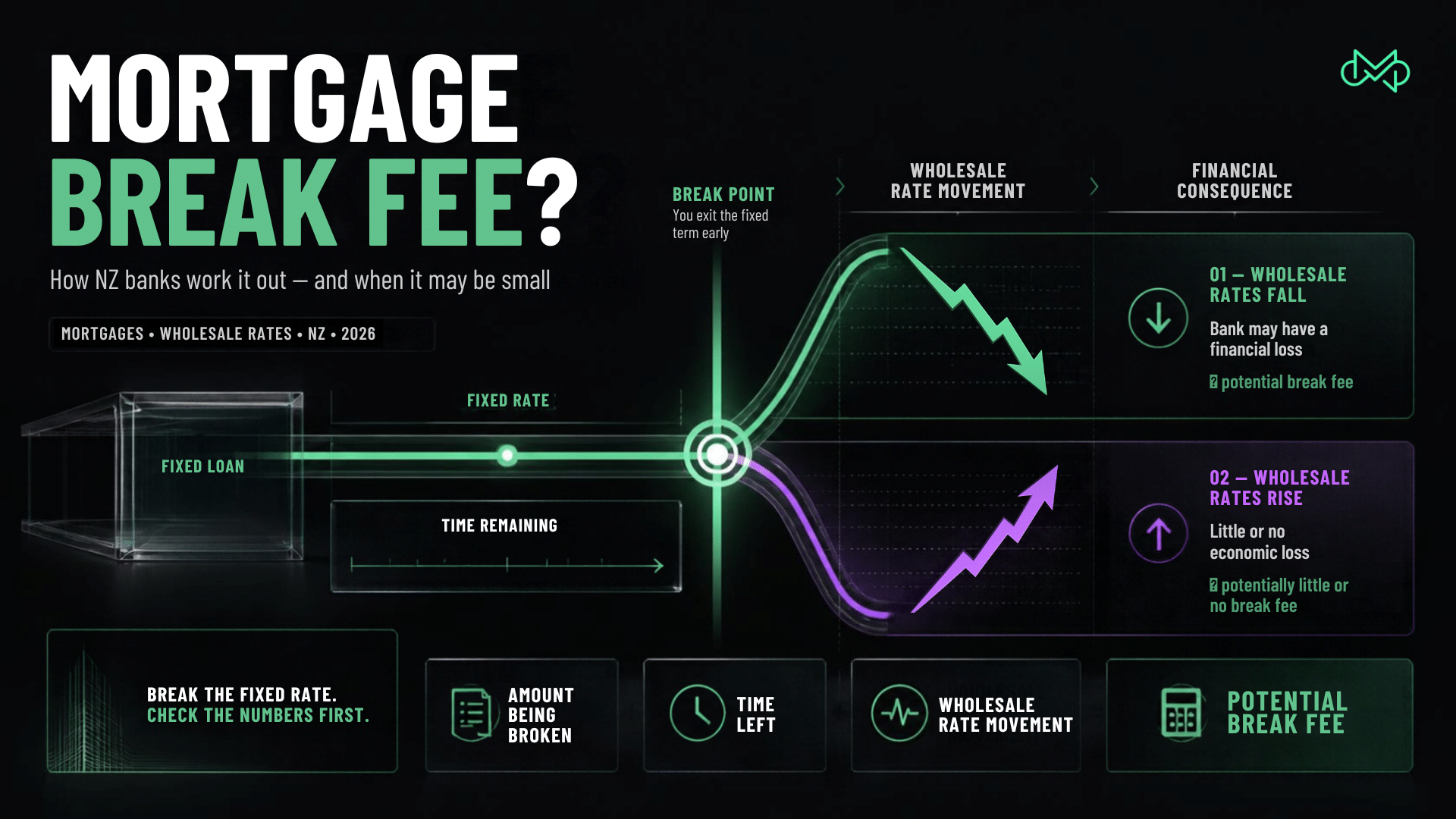
A mortgage break fee is what your bank charges if you end a fixed rate early, for example to refinance, sell or pay the loan off. It covers the interest the bank loses because wholesale rates have fallen since you fixed. If wholesale rates have risen instead, the fee is often zero or close to it, apart from a small admin charge. With the OCR up twice since July 2026, a lot of people fixed at lower rates are now finding their break fee is much smaller than they expected.
Break fee formulas differ between lenders. Always get a written quote from your bank before you decide.
Why banks charge mortgage break fees
When you fix, the bank funds your loan by borrowing at a wholesale rate for the same term. If you leave early, it has to reinvest that money at whatever wholesale rates are now. If those rates are lower, it loses money, and the break fee passes that loss on to you. If rates are higher, the bank isn’t out of pocket, so there’s little or nothing to charge.
Under the Credit Contracts and Consumer Finance Act, fees like this must be reasonable. The bank can recover its actual loss and reasonable costs, not add a penalty on top. Your bank must be able to explain how it worked out the number. The Consumer Protection site has more on your rights as a borrower.
How a mortgage break fee is worked out
Every bank uses its own formula, but most follow the same basic logic:
Amount you’re breaking × the fall in wholesale rates for the time left × the time left
Then the bank discounts that to today’s value and adds an admin fee. Here are two rough examples on a $400,000 fixed loan with 18 months left. The numbers are made up to show the method, not a real quote.
| Wholesale rates have fallen 0.5% | Wholesale rates have risen 0.5% | |
|---|---|---|
| Amount broken | $400,000 | $400,000 |
| Time left | 1.5 years | 1.5 years |
| Bank’s loss (approx) | $400,000 × 0.5% × 1.5 = $3,000 | None |
| Likely fee | A bit under $3,000, plus admin | Admin fee only, if any |
Note that it’s wholesale rates that count, not the rates the bank advertises. The two usually move together, but not exactly. That’s why a quick estimate is only a guide.
What decides the size of the fee
- How much you’re breaking. Only the fixed part counts. Floating and revolving credit have no break fee.
- How long is left on the term. Six months left costs far less than three years left.
- How far wholesale rates have moved since you fixed, and in which direction.
- Whether you can reduce the amount first. Many lenders allow a set amount of extra repayments each year without a fee. Using that allowance before you break can shrink the fee.
Does breaking to refinance save money?
Break fees get a lot of attention. The question that matters is whether you come out ahead after paying one. Work through it in this order:
- Get the break fee quote in writing from your current bank. Quotes change daily because wholesale rates do, so note the date.
- Work out the interest you’d save at the new rate over the time left on your current fixed term.
- Add any cash contribution the new lender offers.
- Subtract the break fee, legal fees and any clawback of a cash contribution you received from your current bank.
If the result is clearly positive, breaking is worth a serious look. If it’s close, waiting until the fixed term ends is usually simpler. In most cases the cheapest time to refinance is when the fixed term ends anyway. The switching banks guide covers the full cost list, and comparing home loan rates explains how to weigh up rates against cash contributions.
There’s also a reason besides rate. If you’re consolidating expensive debt or releasing equity for a renovation or a new purchase, a break fee can be a fair price for getting the structure right now instead of in two years.
Send me your break fee quote and I’ll tell you whether switching now beats waiting.
Check my break fee →Ways to avoid or reduce mortgage break fees
- Time it. Refinance or sell as the fixed term ends where you can.
- Keep terms short if you know a sale or move is coming.
- Split the loan so that not everything is fixed for the same long term. I’ve covered this in fixed or floating?
- Ask about portability if you’re selling and buying. Some banks let you move the fixed loan to your next property instead of breaking it.
- Ask the new lender whether its cash contribution will cover the fee. Sometimes it will.
If you’re selling
Selling one home and buying another is the most common time people get caught out. If the settlement dates don’t line up, there may be a gap to cover with bridging finance. If you’re keeping the same bank, ask about porting the loan before you sign anything. If you’re not buying again, ask for a break fee quote as soon as you list, so the number isn’t a surprise at settlement.
Common questions
How much is a mortgage break fee in NZ?
Can a bank charge a break fee if interest rates have gone up?
Do I pay a break fee on a floating mortgage?
Is it worth breaking my fixed rate to refinance?
Can I negotiate a break fee?
Read next
Switching banks
The full list of costs when you move lenders.
Comparing home loan rates
Weighing a lower rate against a bigger cashback.
Fixed or floating?
Structuring your loan so a break fee hurts less.
Bridging finance
Covering the gap when selling and buying don’t line up.
Talk it through with Yatin. Free, no obligation, and usually one phone call.
Book a free chat →Or call 022 064 7770
This article is general information only and isn’t personalised financial advice. Examples are illustrative, and each lender uses its own break fee formula. Mortgage Sense is a trading name of Yatin Kainth, a Financial Adviser (FSP1007497) providing advice under the Mortgage Managers licence (North West Group Holdings Ltd, FSP682791). See the Disclosure Statement.
Ready to talk it through?
Get mortgage advice NZ homeowners actually trust. Book a free, no-pressure chat with Yatin.
Book a free chat →