

Fixed or floating? How to choose when your mortgage rate comes off in NZ
Should your mortgage be fixed or floating? For most New Zealand borrowers the answer is to fix most of the loan and keep a smaller part floating or on revolving credit. Fixed rates are usually lower than floating, and they give you certainty while the OCR is moving. Floating costs more but lets you pay the loan down with no break fee. If you can’t decide on a term, split the loan across two or three terms so you never refix everything at once.
Rates move often, so check what’s on offer the week you refix.
Fixed or floating: why your mortgage choice matters right now
The Reserve Bank lifted the OCR to 2.5% in July and to 2.75% on 2 September 2026. The next decision is on 28 October. I’ve put the full timetable in the OCR announcement dates post.
A lot of people fixed for one or two years when rates were falling through 2025. Those terms are now ending, and the rate you roll onto is probably different from the one you’ve got. If your fixed term ends in the next few months, choosing between a fixed or floating mortgage is the decision in front of you.
Fixed vs floating mortgage rates in plain terms
| Fixed | Floating | |
|---|---|---|
| Rate | Locked for the term (6 months to 5 years) | Can change at any time, usually soon after an OCR move |
| Usual price | Lower than floating, most of the time | Higher, often by a noticeable margin |
| Extra repayments | Limited. Many lenders allow a set amount a year without a fee | As much as you like, whenever you like |
| Leaving early | Possible break fee | No break fee |
| Suits | Most of the loan, for anyone who wants steady repayments | Money you expect to pay off soon, or a sale coming up |
In short, a fixed mortgage rate buys you certainty and a floating one buys you flexibility.
Revolving credit is a type of floating loan that works like a big overdraft. Your pay goes in, your spending comes out, and you’re charged interest on the daily balance. I’ve written about it in what is a revolving credit mortgage.
How to pick a fixed term
Everyone wants to know which term is “best”. Nobody knows. Fixed rates are priced off wholesale swap rates, and those already reflect what the market expects the Reserve Bank to do. So the one-year rate and the three-year rate are both, in effect, the market’s bet. You’d have to know something the market doesn’t to beat it on purpose.
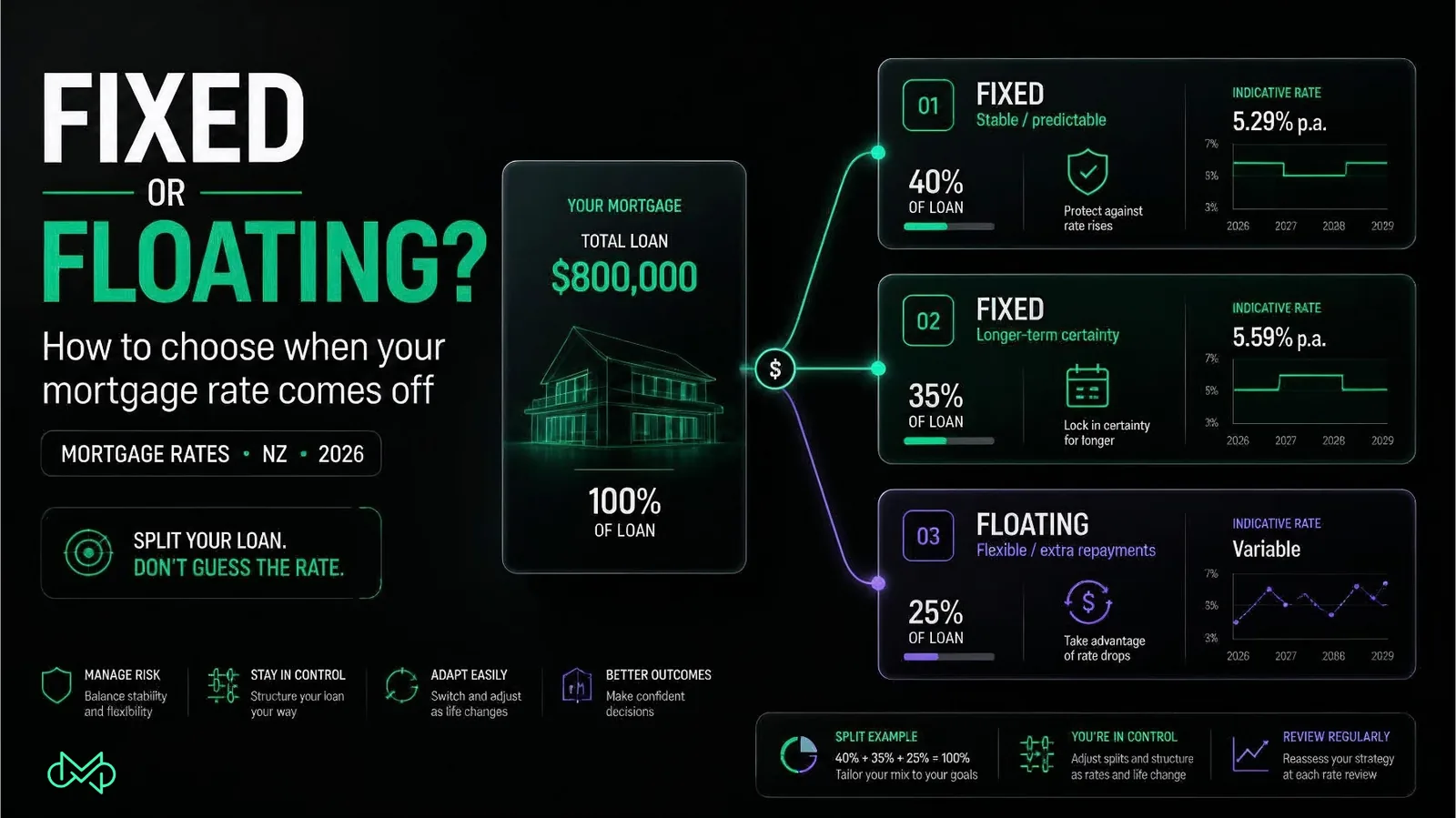
What you can do is work out what would have to happen for one choice to lose. Say a bank offers 5.29% for one year and 5.59% for two years. These are made-up numbers to show the method. Over two years the two-year fix costs you 11.18% in total. For the one-year option to cost more, the rate you roll onto in a year would need to be above 5.89%. So ask yourself whether you think rates will be more than 0.6% higher in a year. If you honestly don’t know, that’s a sign to split rather than pick one.
A few questions narrow it down faster than rate forecasts do:
- Are you likely to sell, move or refinance in the next two years? Keep the terms short so you’re not paying a break fee.
- Is your budget tight? A longer term gives you certainty, even if it costs a little more.
- Are you expecting a lump sum, like a bonus, an inheritance or money from selling another property? Put that amount on floating or a short term.
- Are you close to a big change, like a baby or going self-employed? Lean towards certainty.
Why I usually suggest splitting
Splitting means dividing the loan into parts with different terms, so you don’t have to choose fixed or floating for the whole mortgage. For example, on an $800,000 loan split 40/35/25:
- $320,000 (40%) fixed for one year
- $280,000 (35%) fixed for two years
- $200,000 (25%) on revolving credit or floating
You’ll never get the absolute lowest rate on all of it. That isn’t the goal. The goal is that if rates jump, only part of your loan feels it at once, and if they fall, part of it gets the benefit within a year. The floating part gives you somewhere to put extra money without a fee.
Splits also have a downside people don’t mention. Every split is another refix date, another rate to compare and another decision. Two or three parts is plenty for most households. I’ve seen loans split six ways that the owners had lost track of.
The mortgage repayment calculator shows what each part costs per week or fortnight.
Not sure which split suits you? I’ll look at your rollover and show you the options side by side, including on loans I didn’t arrange.
Review my rollover →Before your fixed term ends
Start about six weeks out. Your bank will send a rollover letter, usually with its carded rates. Those often aren’t the best rates it’s willing to give you.
- Check the date your fixed term ends and the amount on each part.
- Look at what your bank is offering, and ask whether it will do better. Retention teams often can.
- Compare with other lenders. If another bank is clearly cheaper, the switching banks guide covers what moving costs.
- Ask whether you can lock in a new rate early. Some banks let you secure a rate a few weeks before rollover, which is useful when rates are rising.
- If you do nothing, most fixed mortgage parts roll onto the floating rate. That’s rarely what you want.
I review rollovers for free, including on loans I didn’t arrange. It usually takes one phone call.
When a floating mortgage beats a fixed one
Floating the whole loan is unusual, but it fits a few situations. You might be selling in the next few months, so any fixed term risks a break fee. You might have a large lump sum coming and want to pay the loan right down. Or you might be refinancing to another lender soon and don’t want to fix twice. Outside those cases, I’d keep most of the mortgage on fixed rates and use floating only for the part you actually plan to pay off quickly.
Common questions
Is a fixed or floating mortgage better in NZ?
Should I fix for one year or two years?
What happens if I don’t refix my mortgage?
Will the OCR rise change my fixed rate?
Can I pay extra on a fixed rate mortgage?
Read next
OCR announcement dates
When the Reserve Bank decides next, and what it does to your rate.
Comparing home loan rates
Why the lowest advertised rate isn’t always the cheapest loan.
Revolving credit explained
How the floating part of a split can work harder.
Repayment calculator
See what each part of your split costs per week.
Talk it through with Yatin. Free, no obligation, and usually one phone call.
Book a free chat →Or call 022 064 7770
This article is general information only and isn’t personalised financial advice. Mortgage Sense is a trading name of Yatin Kainth, a Financial Adviser (FSP1007497) providing advice under the Mortgage Managers licence (North West Group Holdings Ltd, FSP682791). See the Disclosure Statement.
Ready to talk it through?
Get mortgage advice NZ homeowners actually trust. Book a free, no-pressure chat with Yatin.
Book a free chat →