

I pay $900 a week in rent, so why can’t I get a mortgage?
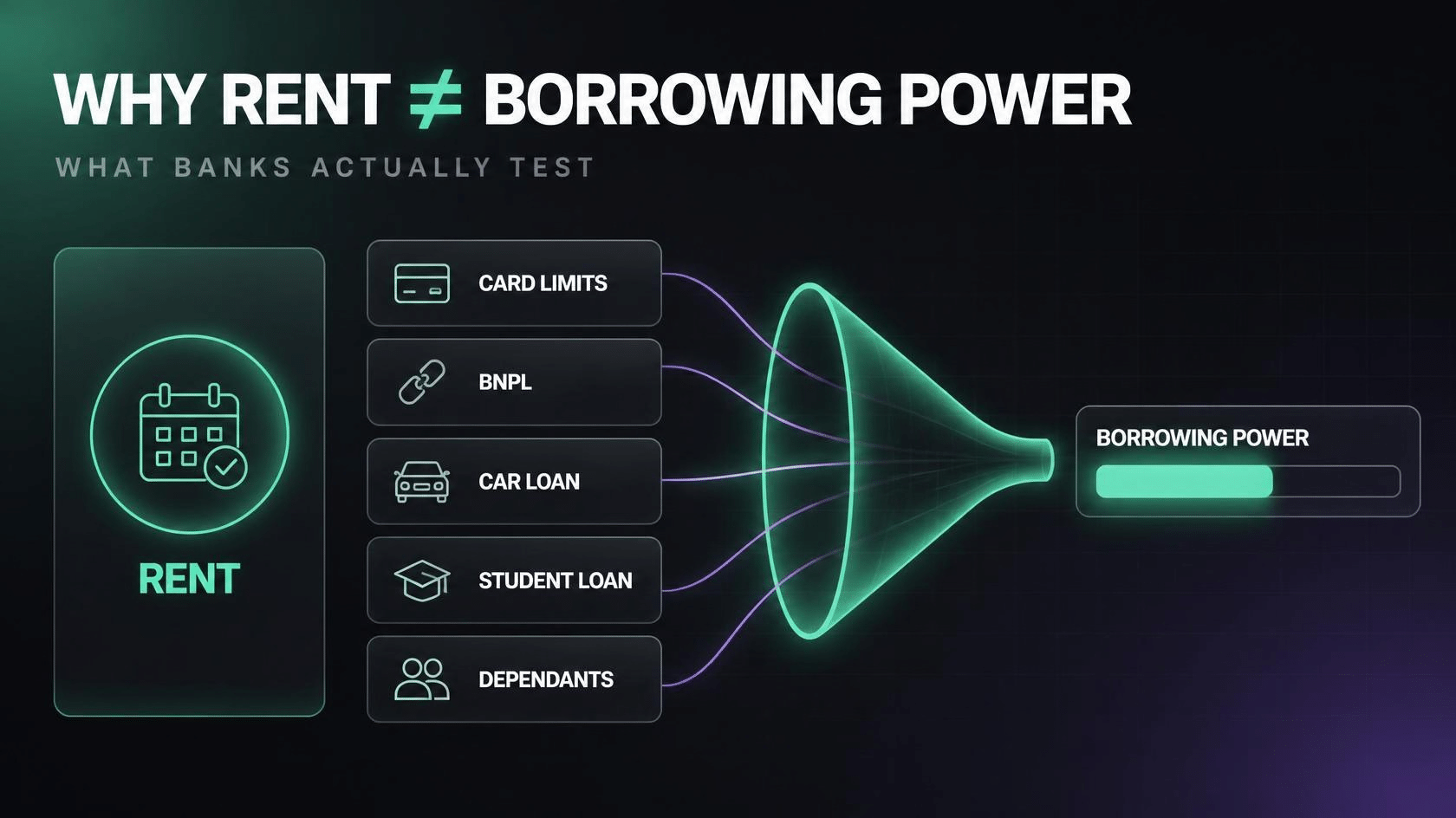
Your borrowing power isn’t measured against your rent. Banks test your budget at a higher “stress” interest rate, count the full limit on every credit card and buy now pay later account, and take off student loan repayments and the cost of dependants. That’s how someone paying $900 a week in rent can still be turned down. The good news is that most of it can be fixed within a few months.
Every lender calculates this differently. Treat this as a guide, not a guarantee.
One of the most-shared posts in the Kiwi First Home Buyers Facebook group lately came from someone who’d been told for the third time that they couldn’t afford a home. They pay $900 a week in rent, have $100,000 saved and only about $15,000 of debt. More than 200 people reacted or commented, and a lot of them said “same”.
It’s frustrating, and I get why people feel the system is broken. But once you see how banks run the numbers, it starts to make sense. More importantly, you can see what to change.
Why rent doesn’t prove your borrowing power
Banks have to show they’ve checked a loan is affordable for you. To do that, they:
- Test at a higher rate than the one you’d actually pay, so they know you could cope if rates rose. Rates have gone up twice this year, so that test has got harder.
- Use their own living cost estimates, which are often higher than what you really spend.
- Count every commitment you have, including some you’ve forgotten about.
So your $900 rent shows good habits, but the bank’s spreadsheet doesn’t treat it as proof.
Five things that quietly cut your borrowing power
1. Credit card limits, not balances
A card with a $10,000 limit and nothing owing still counts against you, because the bank assumes you could spend all of it tomorrow. Cutting the limit or closing cards you don’t use is one of the fastest ways to lift your borrowing power.
2. Afterpay and other buy now pay later accounts
A group member said closing their Afterpay account was a condition of their loan, and asked whether they could open it again after settlement. This comes up a lot. Banks see buy now pay later accounts as debt, and some read heavy use as a warning sign. Close them before you apply.
3. Car loans
A $20k car loan can cut what you can borrow by much more than $20k, because the bank looks at the weekly repayment, not the balance. Another person in the group, whose landlord had offered to sell them the house they rent, had a $20k car loan, a $7k personal loan and a $5k credit card balance on $200k combined income. Clearing the smaller debts first can make a bigger difference than you’d think.
4. Student loans
Someone asked whether they were “helping or hindering” their partner’s application because of their student loan. Once you earn over the repayment threshold, student loan repayments come out of your pay, so the bank sees less take-home income. That doesn’t mean you should leave your partner off the application. Two incomes usually beat one even with a student loan, but run the numbers both ways.
5. Dependants and changes coming up
Another group member asked whether they should tell the bank about a pregnancy. Yes. You have to disclose things you know will affect your income, and banks factor in the cost of children. A good adviser plans around parental leave rather than letting it surprise the bank halfway through.
Been told “not yet” and it doesn’t add up? I’ll go through your numbers and show you exactly what’s holding you back.
Get a free borrowing check →How to rebuild your borrowing power after a decline
- Ask why. Get the actual reason from the bank or your adviser.
- Get a second opinion. Each bank does its sums differently. A “no” from one isn’t a “no” from all of them, and some non-bank lenders are more flexible.
- Fix one thing at a time. Close buy now pay later accounts, cut card limits and pay off the smallest debts, then run the numbers again.
- Give it 3 months. Three months of clean bank statements make a real difference.
Rates matter here too. With the OCR at 2.75% and more rises expected, the stress test may get tougher. My rate comparison guide explains how lenders price your loan.
Common questions
Why was my mortgage declined when I already pay more in rent?
Does Afterpay affect my mortgage application in NZ?
Do credit card limits affect my borrowing power?
Does a student loan stop me getting a mortgage?
How quickly can I improve my borrowing power?
Read next
Kainga Ora First Home Loan
Buying with a 5% deposit: who qualifies.
Repayment calculator
See what a loan would cost you each week.
Comparing home loan rates
Why the lowest rate isn’t always the cheapest loan.
Talk it through with Yatin. Free, no obligation, and usually one phone call.
Book a free chat →Or call 022 064 7770
This article is general information only and isn’t personalised financial advice. Mortgage Sense is a trading name of Yatin Kainth, a Financial Adviser (FSP1007497) providing advice under the Mortgage Managers licence (North West Group Holdings Ltd, FSP682791). See the Disclosure Statement.
Ready to talk it through?
Get mortgage advice NZ homeowners actually trust. Book a free, no-pressure chat with Yatin.
Book a free chat →