

How New Zealand banks assess self-employed income
A salaried applicant hands over three payslips and an employment contract. The bank has a number in about four minutes, and it is a number they trust, because someone else is contractually obliged to keep paying it.
You do not have that. What you have is a business, and the bank’s real question is not how much you earn. It is how confident they are the money keeps arriving for the next thirty years. Those are different questions and the second one takes far more paperwork to answer.
So they look backwards. ANZ, ASB, BNZ, Westpac and Kiwibank all work from a similar starting point: two full financial years showing income that is steady or climbing. That exists because one strong year could be a single contract that never repeats.
Why your assessed income is lower than your real income
This is where most people come unstuck.
Say you are a builder trading through a company. You pay yourself a modest shareholder salary, leave some profit in the business, claim the ute, claim depreciation on your tools, and run part of the house as an office. Your accountant does a tidy job and your taxable income lands at $85,000.
You know the business made more than that. You can see it in the account. But unless someone builds the case properly, the lender assesses you on something near $85,000 and the approval comes back smaller than it should.
That gap between real earnings and assessed income is the single biggest reason self-employed applications get declined or fall short in New Zealand. It is almost never a business problem. It is a presentation problem.
Two years of finalised financial statements is the usual starting point at the main banks. It is a credit policy setting, not a legal requirement, which is exactly why exceptions exist.
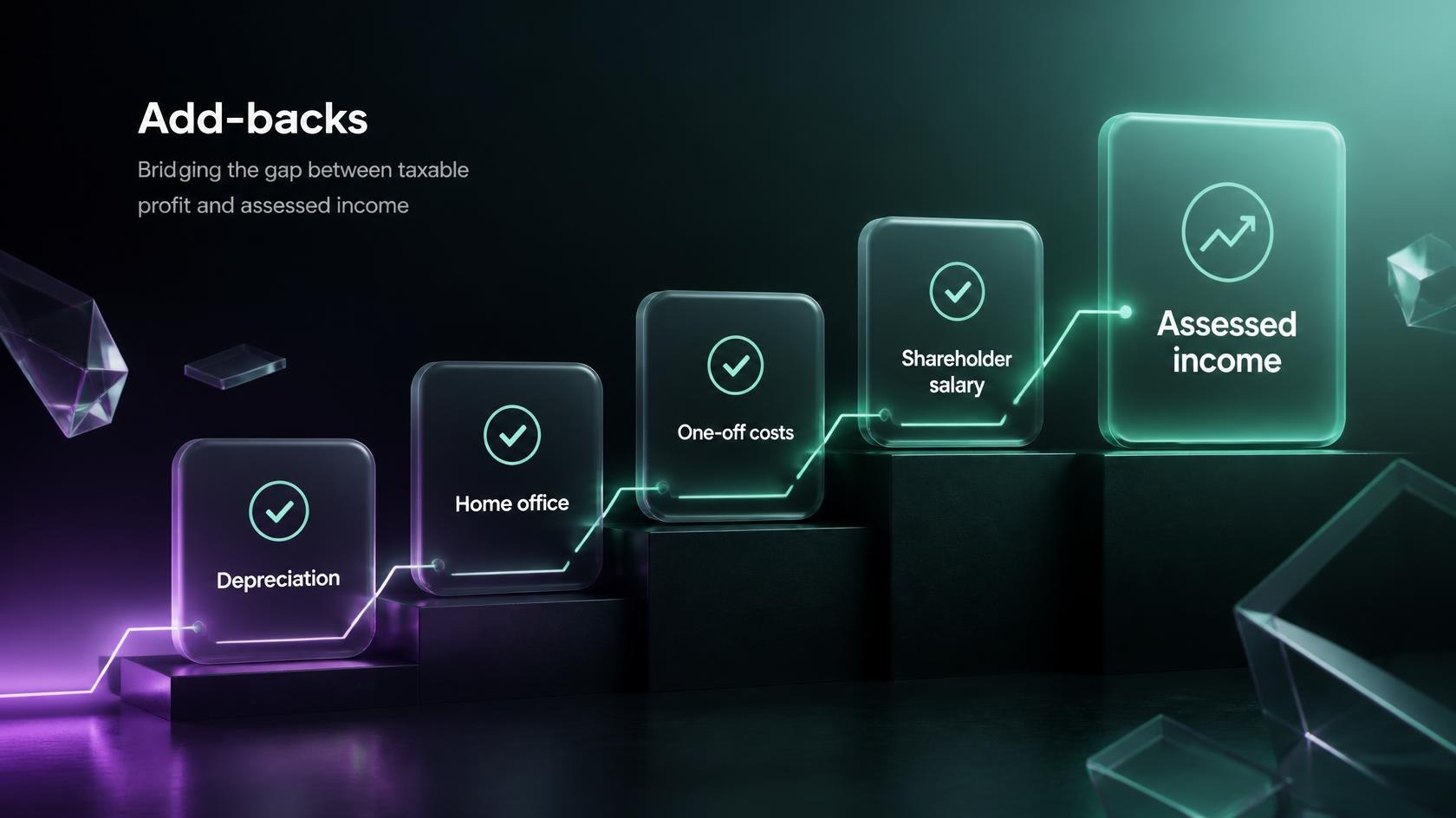
Add-backs explained: the expenses lenders will add to your income
An add-back is an expense in your financial statements that a lender adds back to your profit, because it is either not real cash leaving the business or not a cost that will happen again. Get them right and your assessed income can rise substantially without your business changing at all.
| Add-back | Usually accepted | Why it counts |
|---|---|---|
| Depreciation | Yes, at most lenders | An accounting entry, not cash out the door |
| Home office costs | Usually | You would pay for the house regardless |
| One-off equipment purchase | Case by case | Will not repeat next year |
| Interest on business debt | Varies | Depends how the debt is treated in the application |
| Shareholder salary | Yes | It is your income, just paid differently |
| Retained profits in the company | Varies widely | Some lenders take all of it, some none |
| Non-recurring legal or setup costs | Case by case | Needs a clear explanation |
Two things about add-backs that do not get said often enough.
First, they vary by lender, and not slightly. One bank might count your full retained profit while another counts none of it, and that single difference can move your borrowing by six figures. Choosing where a self-employed application goes is most of the job.
Second, an add-back the lender cannot see is an add-back you do not get. Hand over a one-page summary instead of full financial statements and the depreciation line is not there to add back. I have seen approvals turn on nothing more complicated than sending the complete accounts.
Read next: Add-backs explained: what your accountant claims and what the bank gives back
Documents you need for a self-employed mortgage in NZ
Get these together before you apply anywhere:
- Two years of full financial statements, including profit and loss and balance sheet, not a summary page
- Matching IRD income summaries or notices of assessment for the same years
- Six months of personal bank statements
- Six months of business bank statements
- Recent GST returns if you are registered
- Any long-term contracts you are working under
- A letter from your accountant confirming income and that the business is trading normally
- Proof of deposit and its source
- Photo ID and proof of address
Not sure what your accounts actually say about your borrowing power?
Send them through and I will tell you the number before you apply anywhere.
When one year of financials is enough
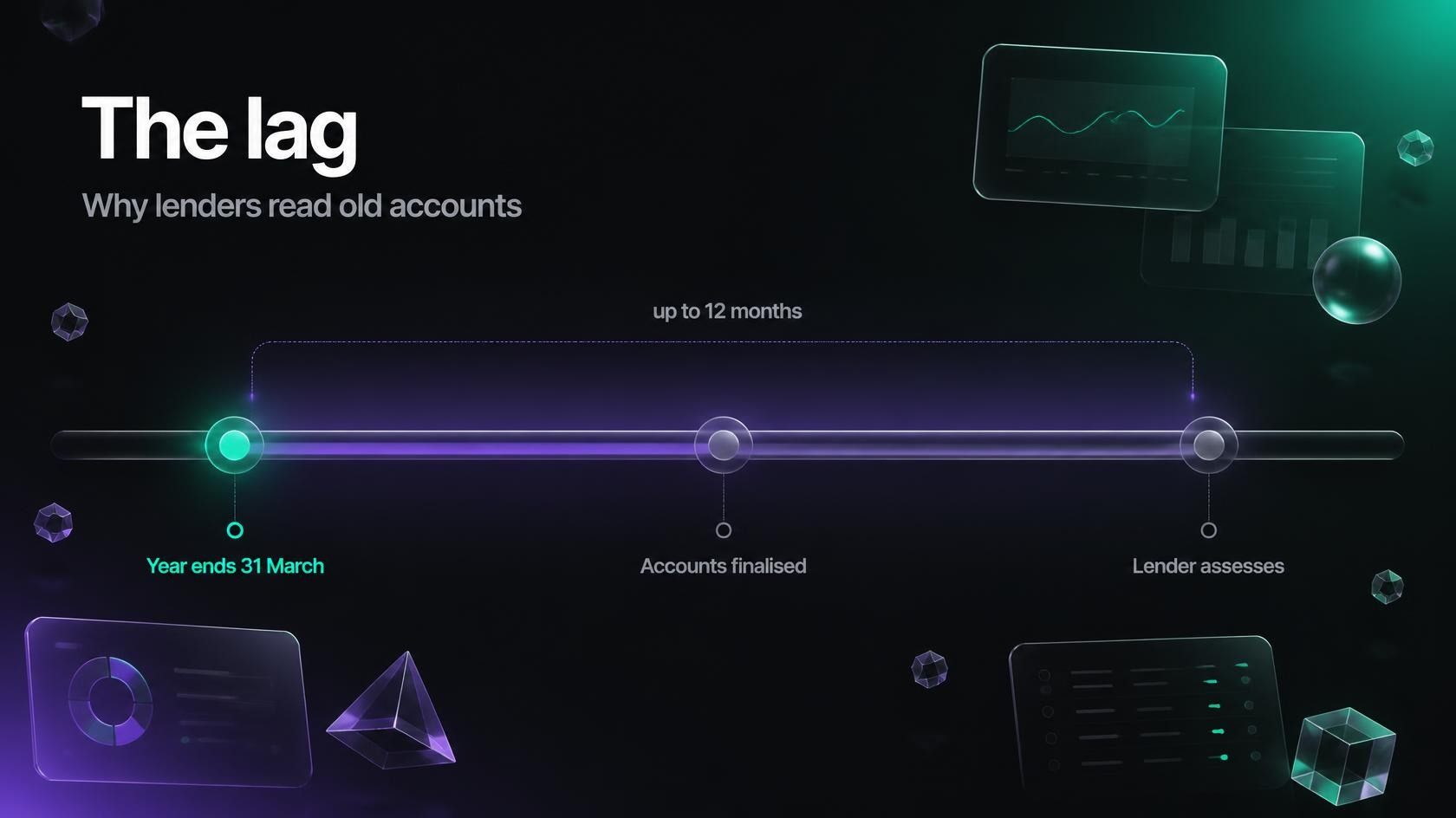
Your financials are older than you think
Most New Zealand businesses have a 31 March balance date. File through a tax agent with an extension of time and that return can legitimately be filed as late as 31 March the following year.
Put those together and the maths gets uncomfortable. A year that ended 31 March can still be unfinalised nearly twelve months later. So a lender assessing you in early autumn may be reading accounts from a trading year that finished two years ago.
That matters enormously if you are growing, because your best year is invisible. It is also why asking your accountant to finalise early is one of the highest-value moves available to you, and it costs nothing but the phone call.
Getting approved with one year of accounts
The two-year default bends more often than people expect. A shorter track record can work when:
- You were doing the same work as a PAYE employee immediately beforehand, same trade, same industry, no gap. Lenders can treat that as continuous experience rather than a brand new venture.
- You are contracting on a long-term arrangement with an established client and can evidence it.
- You have one strong year plus a partial second year backed by GST returns, business bank statements and an accountant’s letter.
- Your deposit is larger, which changes the risk picture even though it does not change the income figure.
Low doc and alt doc options
Second-tier and non-bank lenders work in this space, assessing on GST returns and business banking rather than finalised accounts. The industry has largely moved from “low doc” to “alt doc”, because responsible lending obligations mean nobody is skipping the affordability test, they are just verifying it differently.
The rate is usually higher. Sometimes that is a fair trade for buying now instead of in eighteen months, and sometimes it is not. Worth running both numbers properly rather than assuming either way. Plenty of my clients start on an alt-doc loan and refinance to a main bank once the second year of accounts lands.
Read next: Buying a home when your business is under two years old
What actually caps your borrowing
Being self-employed changes your assessed income. It does not change the rules that income then runs into.
Your borrowing is capped by whichever of these bites first: your deposit and the resulting loan-to-value ratio, the Reserve Bank’s debt-to-income limits, and the lender’s own affordability test run at a stressed interest rate well above the advertised one.
The debt-to-income limits are measured against gross income, with owner-occupier lending generally capped around six times gross income and investors around seven, and banks permitted to write a limited share of new lending above those levels. Self-employment does not touch your deposit. It feeds straight into the other two, which is why a bigger deposit does not repair a low assessed income. Different lever, different lock.
Lenders also benchmark your declared living costs against their own household expenditure model. If what you have written down looks lower than they expect for your household, they use their number, not yours.
Applying at three banks to see who says yes leaves three credit enquiries on your file and can make you look like you have been shopping in trouble. One properly prepared application to the right lender beats three hopeful ones.
Related: How much deposit do you need in NZ and Why home loan applications get declined
Frequently asked questions
Yes, at some lenders, though not all. It is strongest when you were doing the same work as an employee immediately beforehand, or you are contracting to an established client on an ongoing basis. You will need GST returns, business bank statements and usually an accountant’s confirmation to fill the gap.
They average your taxable profit across the last two financial years, then add back expenses that are not genuine cash costs, such as depreciation and home office claims. The resulting figure is what runs through their affordability test, and it is usually lower than the money you actually see.
No, but it can feel that way, because tax deductions push your assessed income below your real income. Getting the add-backs right closes most of that gap.
No. A bigger deposit improves your loan-to-value ratio and often your interest rate, but affordability and debt-to-income limits are calculated from income, not equity, so an income shortfall stays a shortfall.
Two years of full financial statements, matching IRD income summaries, six months of personal and business bank statements, recent GST returns, any ongoing contracts, and an accountant’s letter. Full statements rather than summaries, because a lender cannot add back what it cannot see.
Yes, provided you meet the income caps and the other eligibility criteria. Self-employment does not exclude you, though you will still need to evidence your income the usual way.
It makes it more complicated rather than harder. Some lenders handle multi-entity structures comfortably and others really do not. Picking the right one at the start saves considerable grief later.
If your income is growing, almost always, because fresher accounts mean a higher assessed income. If your latest year is weaker than the one before, the opposite may be true, which is a conversation worth having before anything gets filed.
Find out what you can actually borrow
I work with contractors, tradies and business owners every week. Send me your accounts and I will tell you what the number looks like, which lenders suit your structure, and what to fix before we apply.
This article is general information only and is not personalised financial advice. Lending criteria, lender policies and Reserve Bank settings change regularly. Speak with a mortgage adviser about your own situation. A disclosure statement is available on request and free of charge.