

How credit cards, Afterpay and car loans affect what you can borrow
Banks do not assess your debts on what you pay each month. They assess them on what you could be forced to pay. That single difference explains most of the confusing advice floating around about whether to clear things before applying.
An unused credit card with a 10,000 dollar limit costs you nothing. To a bank it is a monthly commitment of roughly 3% of the limit, which is 300 dollars a month on that card, every month, forever. On a couple with two 8,000 dollar cards they never touch, that is several hundred dollars a month of servicing gone before anyone looks at the mortgage.
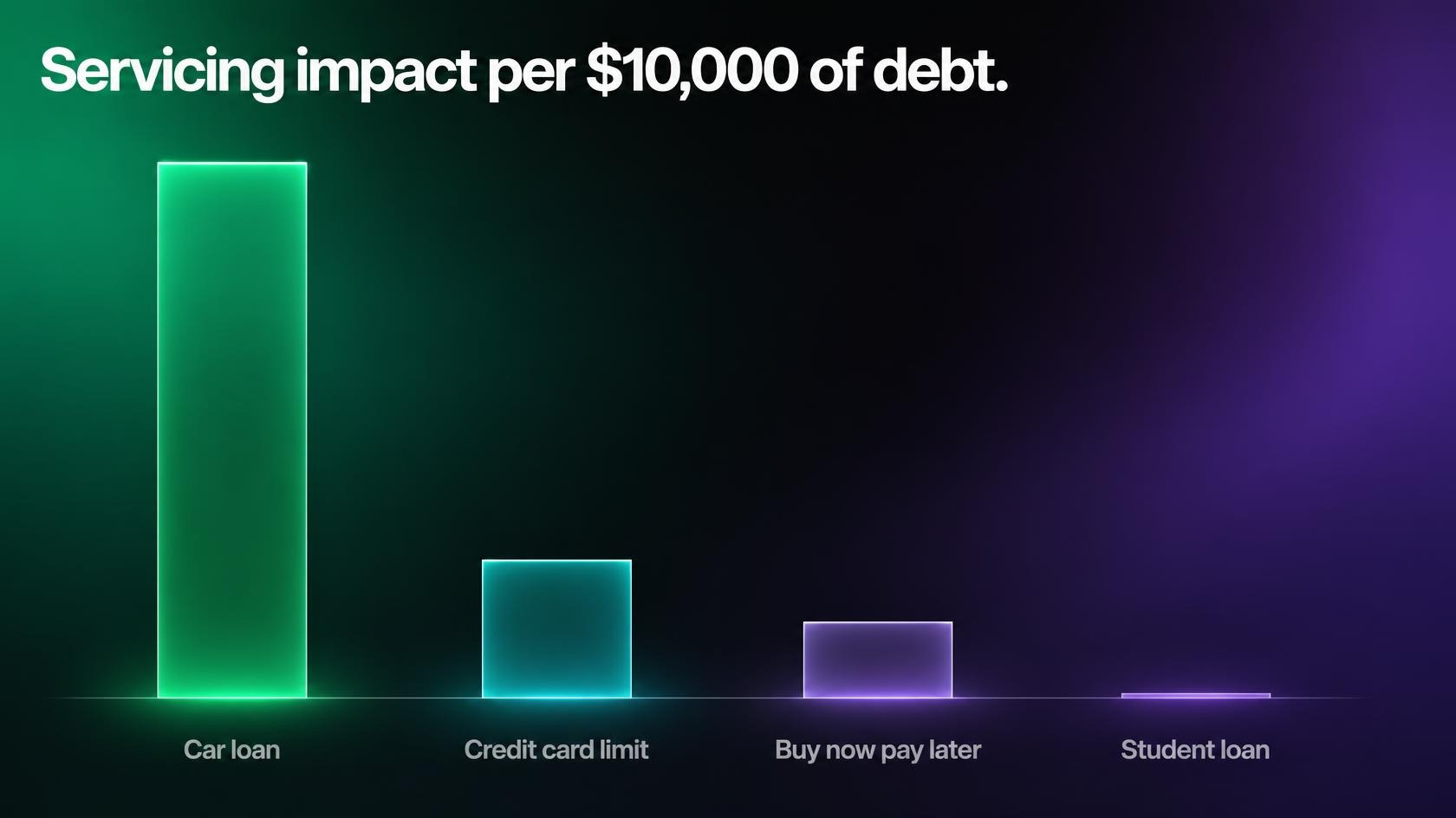
What each type of debt does to you
| Debt | How banks treat it | Worth clearing first? |
|---|---|---|
| Credit card | A percentage of the limit, not the balance | Reducing the limit is usually as effective as closing it, and faster |
| Buy now pay later | Varies by lender, but recent use reads as budget pressure regardless | Yes, and close the account, not just clear it |
| Personal or car loan | Actual repayment, until the term ends | Usually the highest impact per dollar repaid |
| Student loan | The 12% repayment on income above the threshold | Almost never worth clearing early |
| Hire purchase and Q Card | Same as a personal loan, and often at a worse rate | Yes |
| IRD arrangement | Actual repayment, and it raises questions about conduct | Clear it or have the arrangement documented |
The student loan question, answered properly
This comes up constantly and gets answered badly. A student loan is not treated like other debt. It has no interest while you live in New Zealand and the repayment is a fixed percentage of income above the threshold, so it behaves more like a tax than a loan.
Someone with a 2,000 dollar balance finishing in December and someone with a 16,000 dollar balance are treated almost identically by the servicing calculation.
Paying 16,000 dollars off a student loan to improve your borrowing power is usually a bad trade. That 16,000 in your deposit does far more work than the tiny servicing improvement.
The car loan question, answered properly
The opposite. A 26,000 dollar car loan with three years to run is a real repayment coming out every month and it eats servicing directly. Clearing it, if you can do it without gutting your deposit, typically lifts your borrowing capacity by well more than the amount you paid off.
The awkward version, which comes up constantly: someone has 20,000 saved and a 20,000 car loan. Pay the loan and you have no deposit. Keep the loan and you cannot service. The honest answer is that there usually is not a clever way out of that one, and the sequence depends on how far off 5% or 10% you are. Worth modelling both before deciding.
That car loan versus deposit trade-off is worth modelling properly rather than guessing at. We will run both versions for you.
Model both scenarios →Buy now pay later deserves its own paragraph
Afterpay, Laybuy and Zip do not appear on your credit file the way a loan does, so people assume they are invisible. They are not. Your last three months of bank statements go to the lender, and a fortnightly pattern of instalments is obvious.
Some lenders treat it as a commitment. Some treat it as a sign that day to day spending is tight. Neither helps.
Close the accounts rather than just clearing them, and do it at least three months before you apply so the statements are clean.
Does closing a credit card hurt my credit score?
Slightly, sometimes, and it matters much less than people fear. A New Zealand mortgage decision is driven by servicing capacity and conduct, not by a score in isolation. A clean record with no missed payments, no defaults and no recent enquiries is what a lender wants.
One person had a score of 771 out of 1,000 and was still worried about it. That score was never the issue in their application.
Defaults are the exception. An unpaid default of any size is a live problem, and one at 10,000 dollars will stop most main bank applications until it is resolved. Deal with those first, before anything else on this page. If a default is already on your file, the bad credit options page covers what is still possible.
A sensible order of operations, six months out
- Close every buy now pay later account.
- Reduce credit card limits to what you genuinely use, or close the cards.
- Clear or resolve any default, and get confirmation in writing.
- Clear short-term high-repayment debt, car and personal loans first.
- Leave the student loan alone.
- Stop applying for anything new, including a phone on a plan.
Common questions
Will the bank know if I close my Afterpay account the week before applying?
Can I get a mortgage with a default?
Does a car on hire purchase count differently from a car loan?
Should I consolidate my debts before applying?
Does closing a credit card hurt my credit score?
Is reducing my card limit as good as closing the card?
Where these rules come from
Anything on this page set by government or the regulator is described as a rule rather than a fixed number, because the numbers change. Check the current position at the source.
- Inland Revenue, student loan repayment thresholds and rates
- Reserve Bank of New Zealand, macroprudential policy
Read next
How much can I borrow
The full servicing calculation these debts feed into.
Using KiwiSaver for your first home
Where the deposit side of the equation comes from.
Debt consolidation
When rolling debt into a mortgage helps, and when it quietly costs more.
First home buyers
The full guide from first conversation to keys.
Ready to talk it through?
Get mortgage advice NZ homeowners actually trust — a free, no-pressure chat with Yatin.
Book a free chat →